
Lateral canthoplasty and a lower-lid opening — the two procedures that work on the outer corner of the eye — are a common choice for people who want larger, softer eyes.
Neither operation fixes its early result permanently. As time passes the divided tissue heals and part of the space that was opened closes again. A plan therefore has to allow for that contraction from the outset, working from how the eye looked before surgery. But skin behaves differently from one person to the next, and so does the speed of healing, which makes predicting the final result without any margin of error very difficult.
Every face also carries some degree of natural asymmetry. Even when the amount of opening is designed differently for each side, small and unexpected differences can still appear during recovery.
Why asymmetry appears after these procedures, and why it is hard to predict
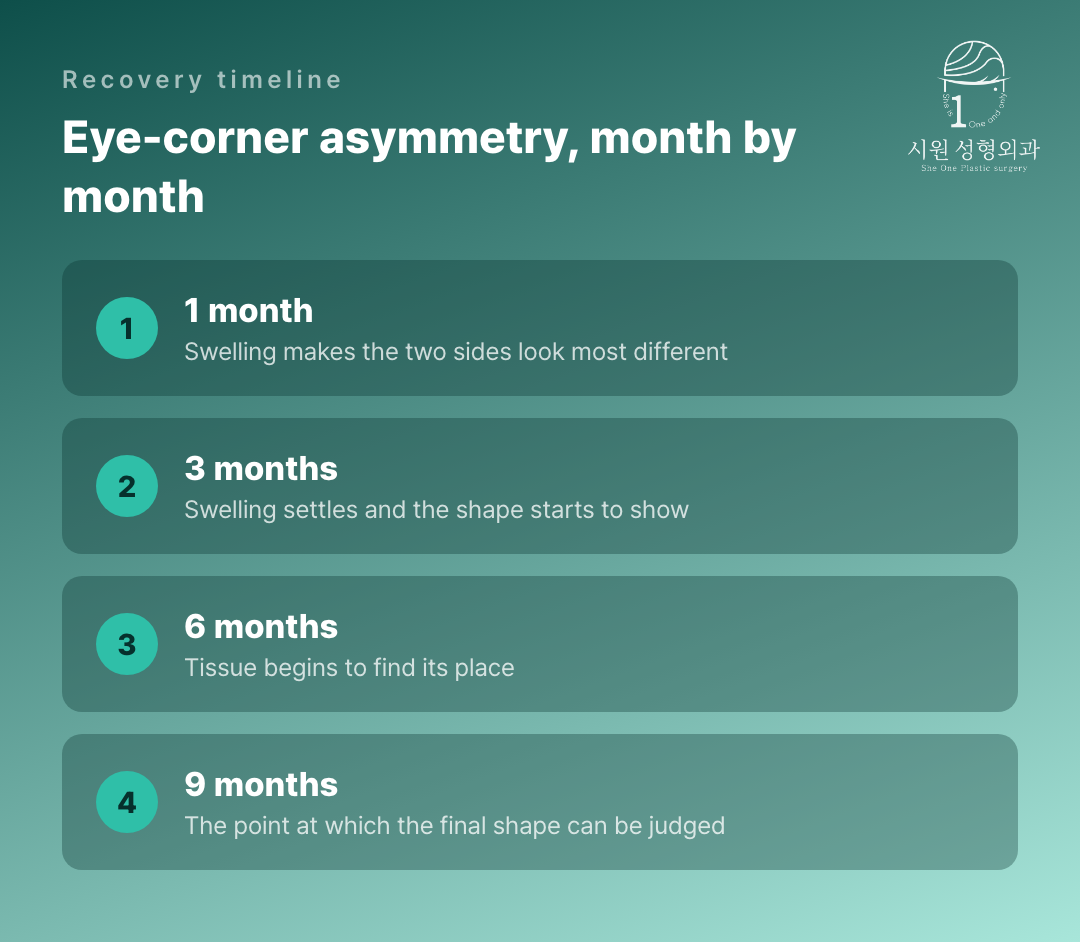
Soft tissue divided during lateral canthoplasty or a lower-lid opening usually stabilises over six to nine months. Through that period the amount of opening tends to decrease somewhat from where it began.
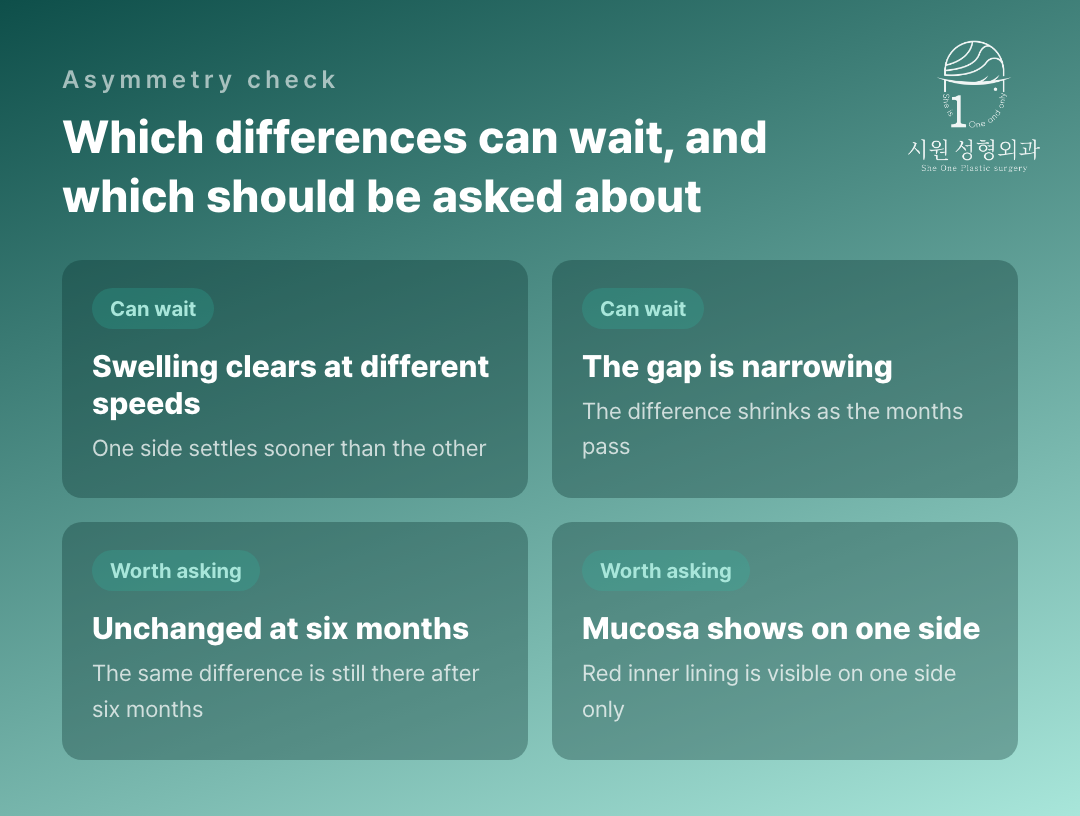
How much any one person contracts, and how quickly the tissue heals, varies widely with skin elasticity and healing capacity, and that limits how precisely the outcome can be predicted. Even when the same amount is excised and sutured on both sides, the two sides respond at different speeds and form scar differently, so a temporary asymmetry can appear. If the eye already showed a marked difference in globe projection or in the height of the outer corner before surgery, matching the two sides can remain limited by the underlying skeletal structure, even when a different amount is applied to each side.
What changes visually when the outer corner and the lower lid are corrected
Lateral canthoplasty adjusts the angle and the position of the lateral canthus, the outer corner of the eye. A sharply upturned eye can be brought down into a softer line. After surgery the sclera (the white of the eye) exposed on the outer side increases by roughly 10 to 20 per cent, which gives the impression of a longer and more open eye.
A lower-lid opening works the other way. It draws the upward slope of the lower eyelid (the lower lid margin) down into a gentler line, so the lower and outer parts of the iris that had been covered become visible and the eye looks taller.
These changes show more clearly and more naturally once the internal structures that were disturbed have bonded firmly — from three to six months onward — rather than in the first weeks while swelling is still present.
Why the course matters more than any single moment
In the early recovery period, around two months after surgery, the difference in how quickly swelling clears on each side and in how flexible the lower-lid tissue is can make a temporary asymmetry quite noticeable.
This is a normal part of a wound healing. In most cases the scar softens with time and the tissue settles back into place, and the asymmetry improves. Rather than deciding on a revision too early, it is important to follow the course through staged check-ups at two months, six months and nine months. If a clear difference between the two sides remains after a full recovery period, that is the point at which to discuss a further correction with the medical team.
A diagnosis built around the individual patient
She One Plastic Surgery works specifically in eye surgery and eye revision surgery (blepharoplasty revision), and does not practise assembly-line care. A one-to-one assessment before surgery examines the anatomy in detail: the position of the outer corner, how much skin there is to spare, how far the globe projects.
Opening procedures are delicate work that has to account both for the asymmetry a patient already has and for the contraction that occurs while healing. In consultation we set out not only what the operation can achieve but also the limits that may be met during recovery, openly and without leaving anything out, so that patients can concentrate on their recovery with confidence.
Individual recovery times and results vary, and side effects can occur. Please consult our medical team before making any surgical decision.
Official WebsiteProcedures and medical staff›
KakaoTalk ConsultationSend us photos and ask›
LINE ConsultationEasier if you are outside Korea›
DirectionsApgujeong Stn. · JJ Building 2F›
2F, JJ Building, 19 Apgujeong-ro 28-gil, Gangnam-gu, Seoul, Korea
Mon–Fri 10:00 – 19:00 · Sat 10:00 – 16:00
Closed Sun & public holidays · 02-512-1889
