
Are the two creases sitting at clearly different heights after double-eyelid surgery, or does one lid alone feel heavy and droop?
Unevenness that appears after surgery can be a matter of the outer line alone — the skin that was fixed down. It can equally be a functional problem rooted in a difference in the tension of the muscle that opens the eye. If the two are not told apart — whether the first operation fell short at a shallow skin adhesion or at the depth of the muscle — and the outer line is simply tied again, the unevenness comes back. What follows sets out, as objectively as we can, the diagnostic ground on which a crease revision alone is chosen over a revision combined with ptosis correction.
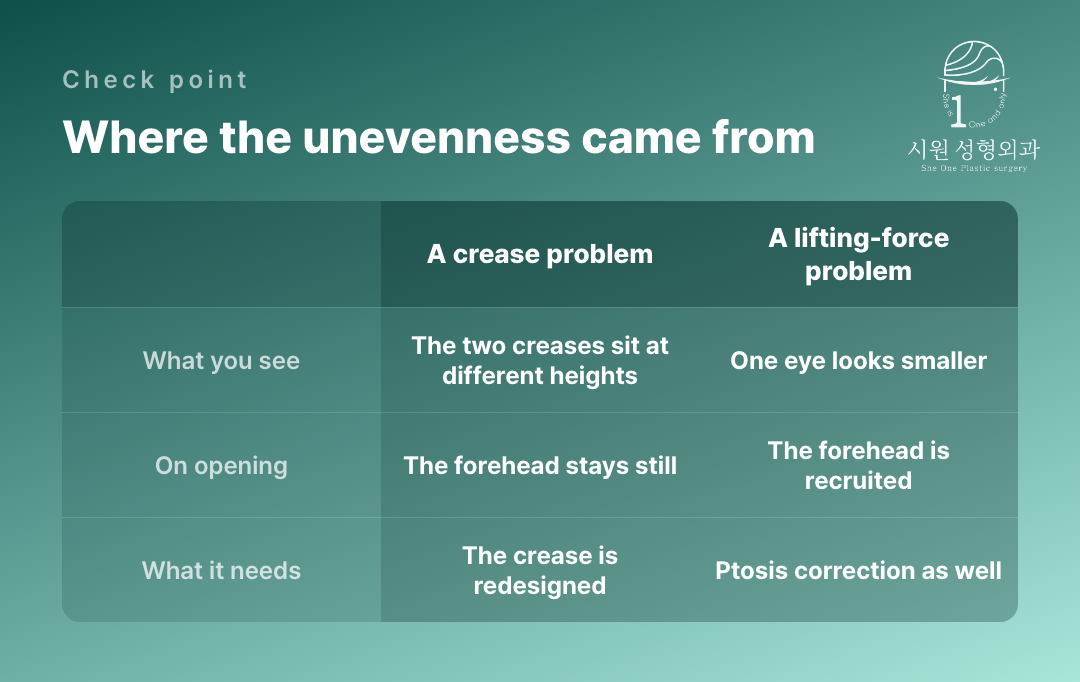
Where the unevenness comes from, and what each cause needs
Unevenness after double-eyelid surgery cannot be resolved by one standard method. The surgical approach has to follow the reason the first operation fell short.
- A difference in muscle function (with ptosis) — if one eye opens less, or the forehead and brow are recruited heavily on opening, the tension balance of the levator (the muscle that lifts the lid) has been lost. A crease revision that touches only the skin will not resolve it; ptosis correction, which tunes the strength of the muscle precisely, has to be carried out alongside.
When the lifting force differs on each side
Cases from our official Naver blog.
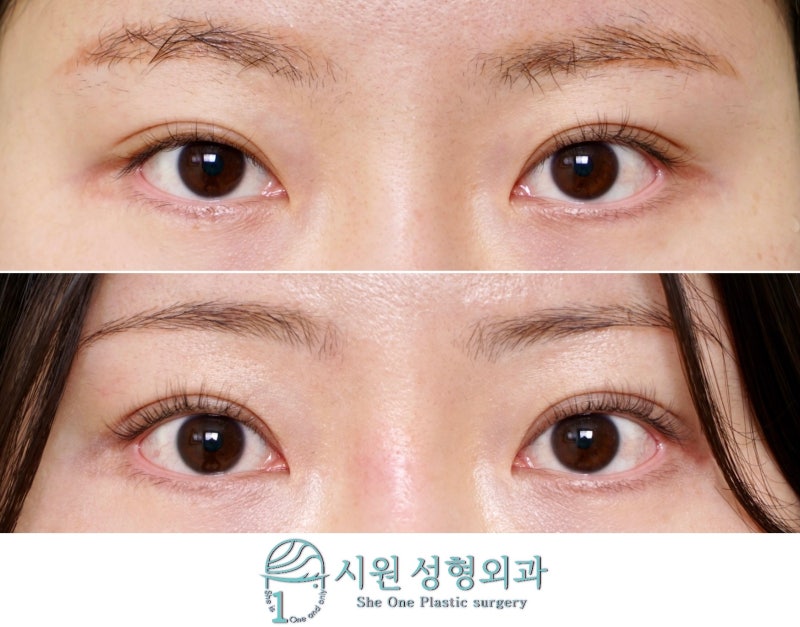
One-sided ptosis correction brought the two sides level ›
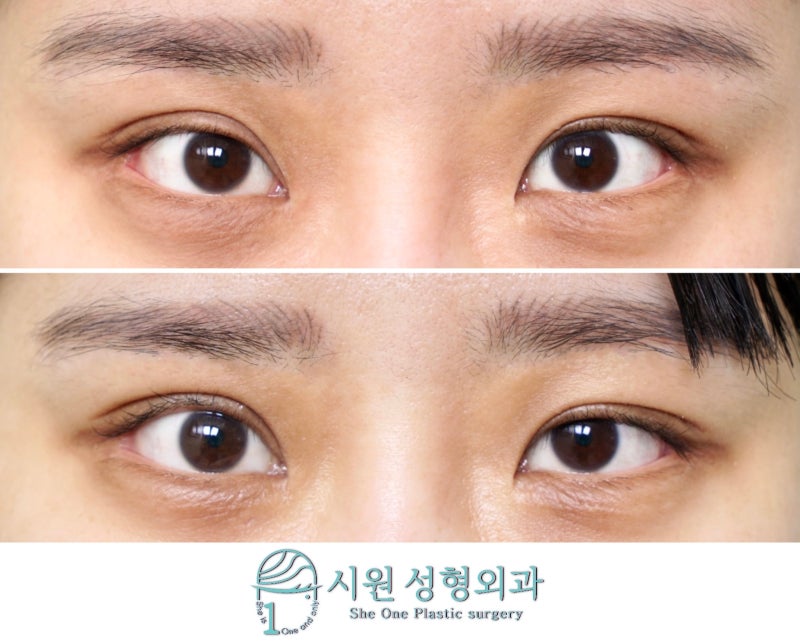
When the inner end of the crease became a straight line — day 5 ›
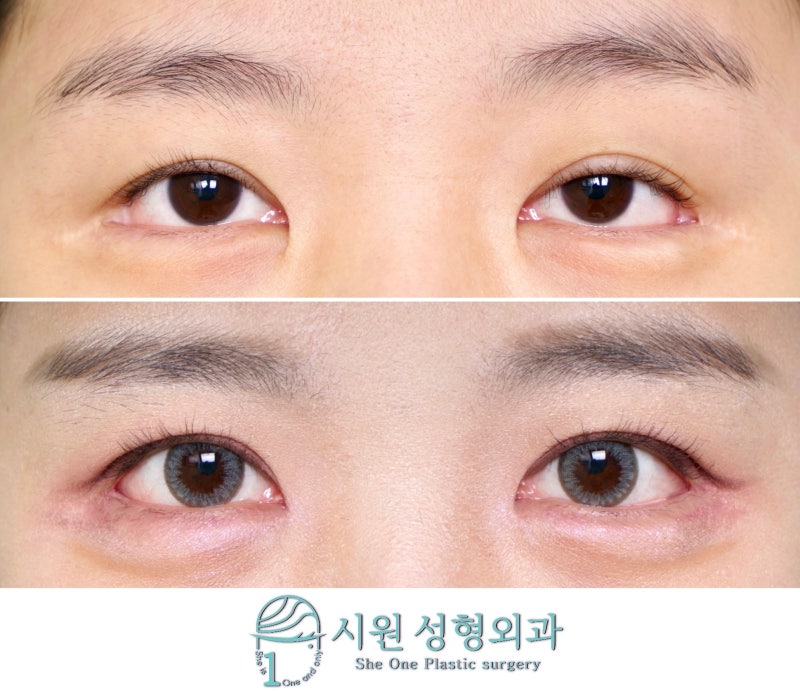
Unevenness from a difference in lifting force — two months ›
The before and after photos in this post are published with the patient’s consent.
- An error of design or of adhesion — the lifting force is normal, but one line alone has come undone, or the two sides were set at different heights at the first operation. Releasing the adhesion that formed in the wrong place and redesigning the line along a new path can correct this as a crease revision alone.
When only the crease has come undone
Cases from our official Naver blog.
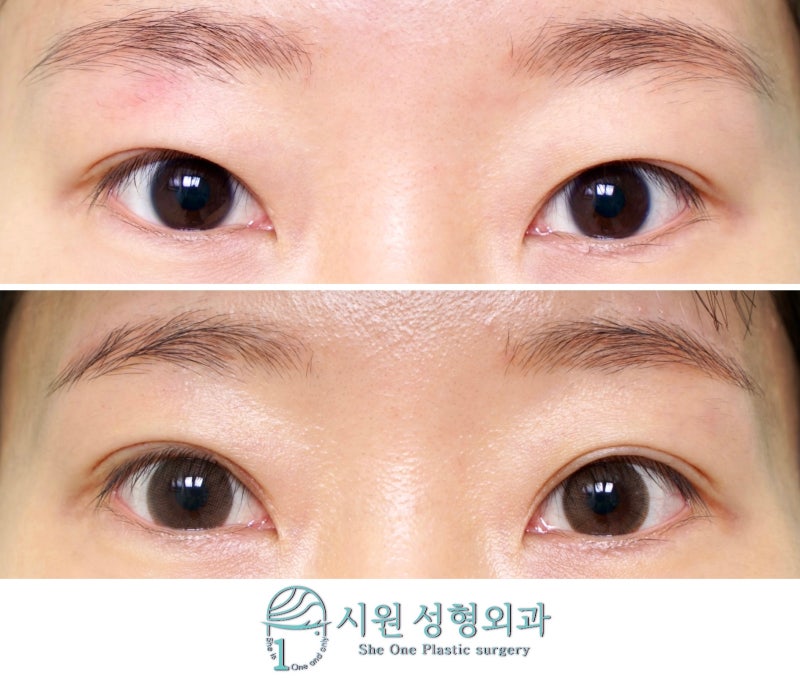
A crease revision without an incision — seven months ›
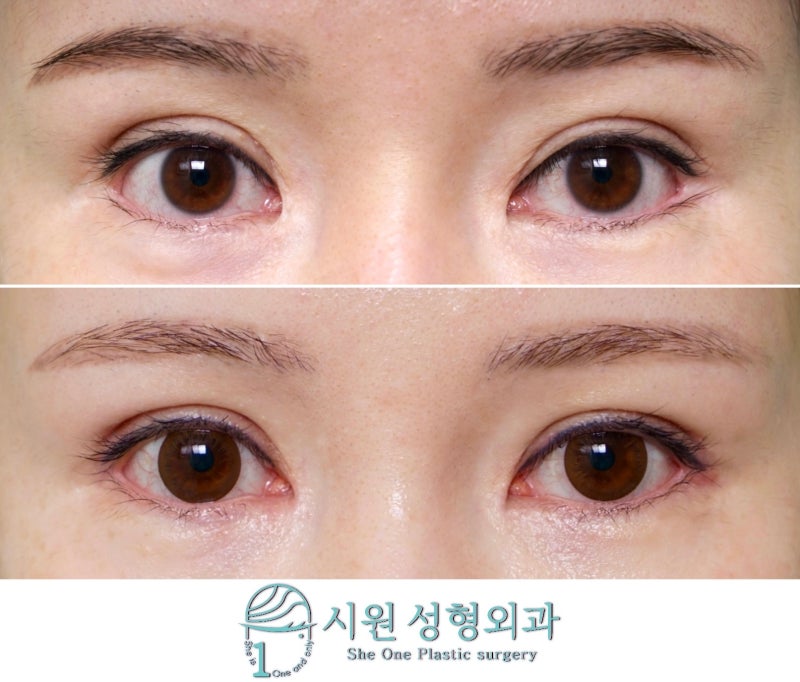
Crease and inner, outer and lower corners restored together — two months ›
The before and after photos in this post are published with the patient’s consent.
- Both causes together — where an uneven line and a difficulty in opening the eye (a sleepy look) are present at once, the existing adhesion has to be released while ptosis correction is carried out, so that skin and muscle are brought back into balance in one go.
When both are present at once
Cases from our official Naver blog.
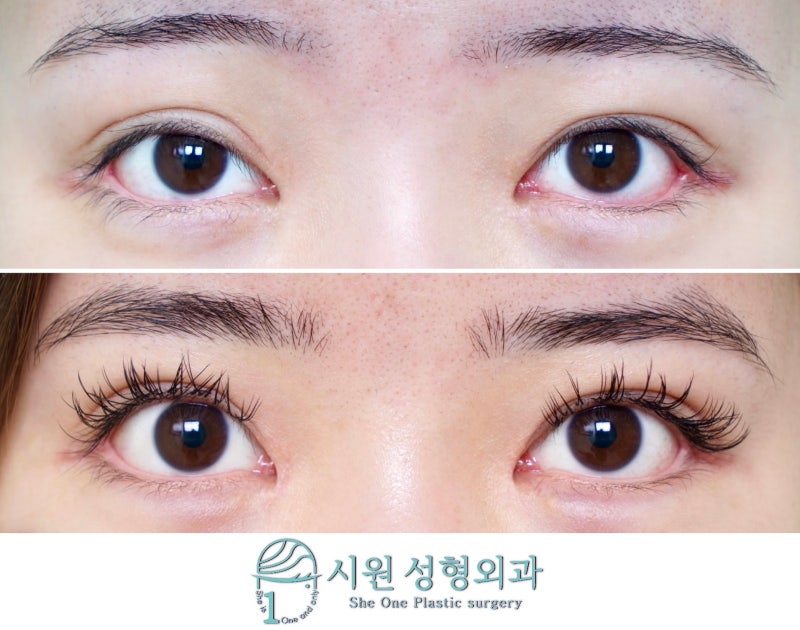
A sausage-like lid with an outer-corner scar — one year after revision ›
Crease and inner, outer and lower corners restored together — two months ›
The before and after photos in this post are published with the patient’s consent.
When is it safe to correct?
In the period right after surgery the swelling and the scar adhesion are still changing from day to day, so judging by appearance alone is not advisable. As a medical principle, the safest course is a detailed assessment and a revision plan at a minimum of six months after surgery, by which time the scar tissue has softened and the final shape of the eye has emerged. (Where a functional complication or a clear design error is identified within the first two weeks, earlier correction may be considered at the surgeon’s judgement.)

A self-check list for considering revision
If the following persist after a full recovery period of six months, the thickness of the eyelid tissue and the function of the muscle should be assessed together again.
- A difference in the absolute height of the two lids of 1 mm or more clearly persists.
- Opening one eye in particular takes a heavy effort from the forehead or the brow.
- People often remark that the unevenness makes the eyes look tired.
- The covered lid obscures the iris so the field of vision feels narrower, or an extra fold has formed.
Questions we are often asked
If only one side has come undone, can surgery be done on that eye alone?
Even when only one line looks to be at fault, the other eye is often already showing a slight asymmetry or a compensatory muscle effort. The tension balance and the muscle strength of both eyes have to be assessed together before the extent of the correction is decided; that is what reliably prevents a second asymmetry later on.
Does adding ptosis correction make recovery longer?
Ptosis correction works down to the muscle layer, so residual swelling can last somewhat longer than after a revision that deals only with skin. But where the underlying cause of the unevenness is the muscle, accepting that slightly longer recovery is what makes a symmetry that does not come undone with time.
Tracing the cause backwards
Eye revision surgery is not a matter of tying a loosened line again. It is a precise reconstructive process that traces backwards why the first operation fell short, through the anatomy and the chain of cause behind it.
In a one-to-one assessment we analyse the condition of the remaining tissue and the function of the muscle in three dimensions. By telling clearly whether a case genuinely calls for ptosis correction, we aim to restore a safe and healthy symmetry without treatment that is not needed.
The before and after photos featured in this post are shared with the patient’s explicit consent in accordance with the Medical Service Act. Individual recovery times and results vary, and side effects can occur. Please consult our medical team before making any surgical decision.
WhatsApp ConsultationInternational patients welcome›
Official WebsiteProcedures and medical staff›
KakaoTalk ConsultationSend us photos and ask›
LINE ConsultationEasier if you are outside Korea›
DirectionsApgujeong Stn. · JJ Building 2F›
Consultations are held in English with the surgeon and our staff directly, not through an interpreter. Written enquiries in English are welcome.
2F, JJ Building, 19 Apgujeong-ro 28-gil, Gangnam-gu, Seoul, Korea
Mon–Fri 10:00 – 19:00 · Sat 10:00 – 16:00 · (KST, UTC+9)
Closed Sun & public holidays · +82-2-512-1889
