
Why does the crease keep going faint?
A crease that was sharp after surgery grows fainter over time and finally gives way. People thinking about a revision for that usually arrive with the same worry in front of them — what if it just loosens again. When the two eyes start looking different in the mirror as well, the decision gets harder still.
A crease is not simply a fold pressed into skin. It is held by adhesion — tissue binding to tissue — between the skin, the muscle, and the supporting structure beneath. Where that adhesion is weak or never formed completely, the crease shallows and eventually gives. Surgical method and the condition of the lid itself both feed into it, which is why establishing why it loosened comes before deciding on a revision.
The structural reason a crease loosens
How a crease forms depends on the method. A buried-suture technique fixes a few points with thread and leans entirely on the holding power of that thread; as knots slacken over time, or where adhesion never settles between the layers, the crease tends to shallow. An incisional technique creates the adhesion directly and the bound area is generally wider — but making an incision does not mean it cannot loosen. Where surplus fat remains in the lid, or the skin is thick and heavy, a force pushes the bound surfaces apart and the crease can widen or give.
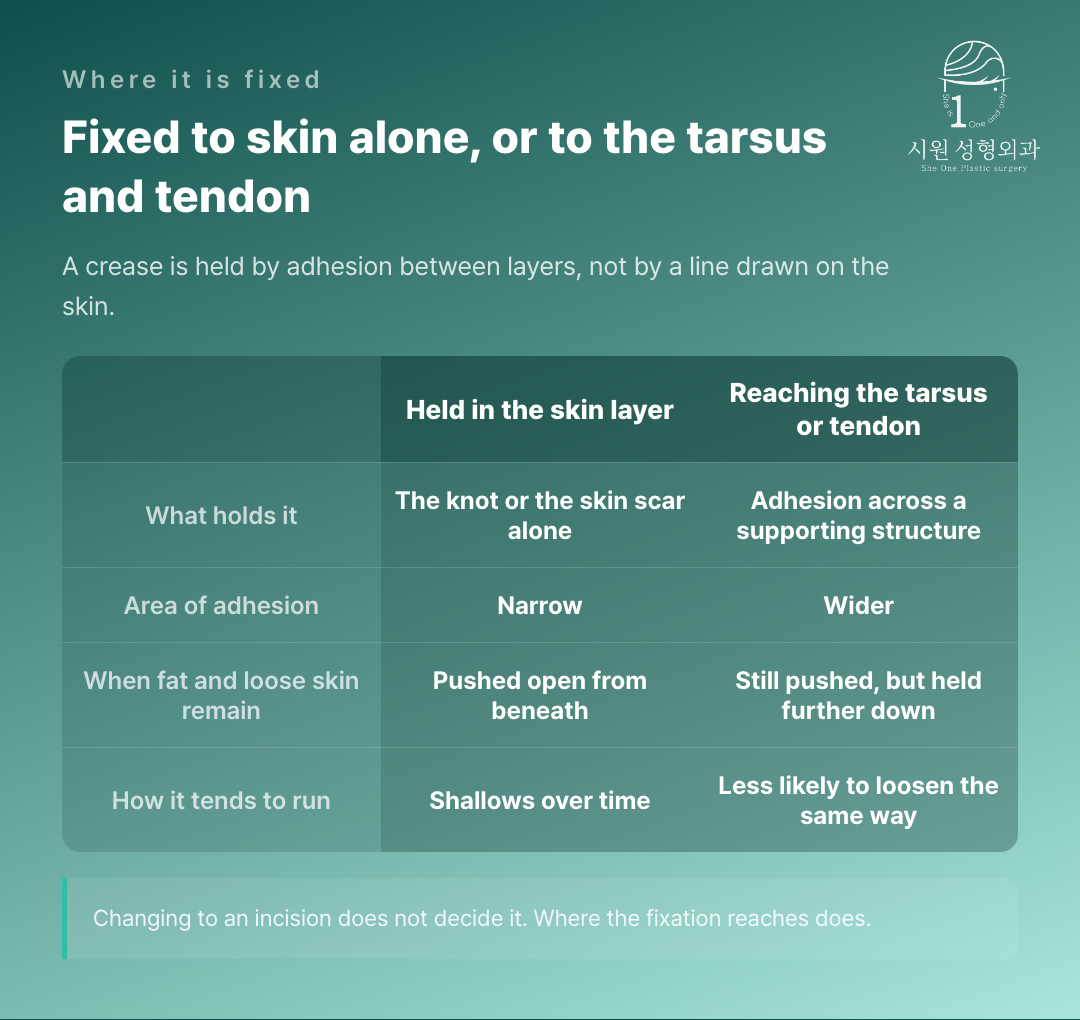
A crease is held by the skin, the orbicularis muscle that closes the eye, the tarsus — the firm plate that supports the lid — and the tendon of the levator muscle that opens it, all bound to one another. There is a textbook chapter given over to the crease on its own in the oculoplastic literature, which is a measure of how basic this structure is to eyelid surgery. Skin losing its elasticity with age, a lid that carries thick fat to begin with, or a first operation where the fixation was not strong enough all loosen a crease by the same mechanism.
Does changing to an incision settle it?
A crease that has loosened does not lead to the same revision in every case, and changing to an incision is not in itself the answer. An incision whose fixation stops in the skin layer can see the same thing come back; fixation that reaches a structure which genuinely holds the crease — the tarsus, or the tendon of the levator — works in the direction of making recurrence less likely. Where the fixation reaches matters before the name of the method does. Rather than repeating a buried-suture technique, the point is to make conditions in which the adhesion can settle.
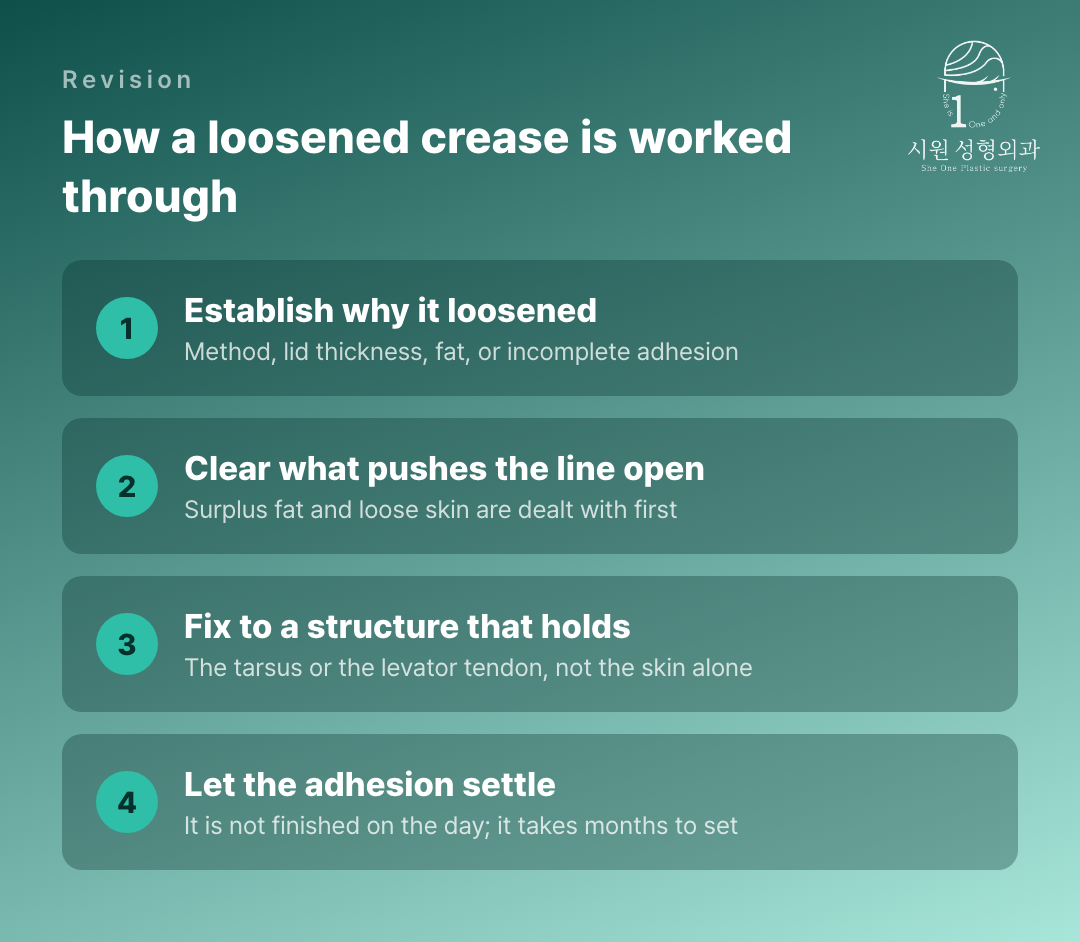
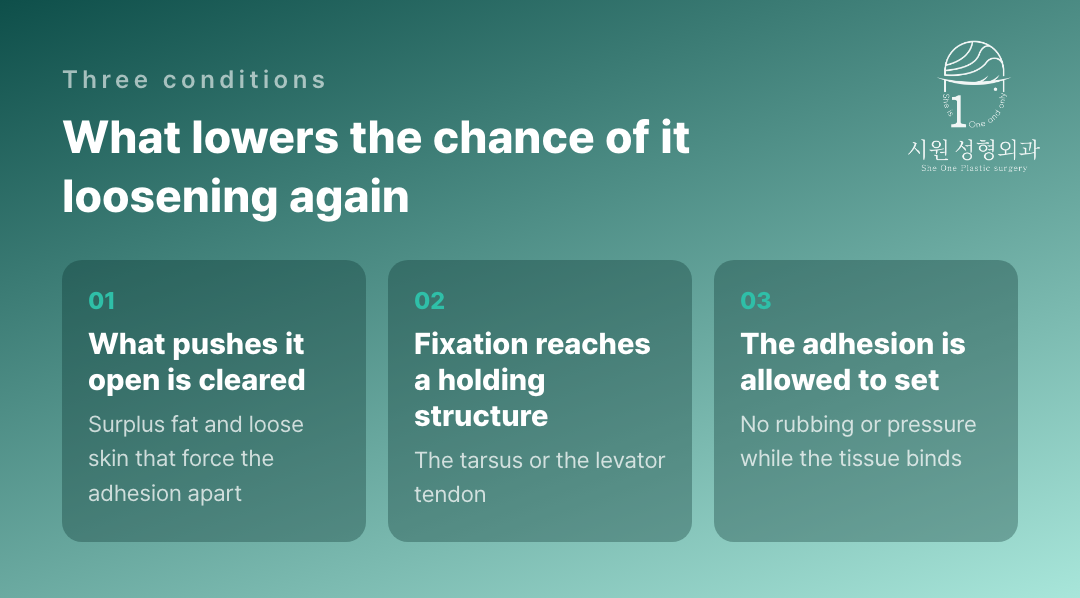
Three things work in the direction of lowering the chance of recurrence. Having all three does not mean it cannot loosen. First, whether surplus fat and loose skin that push the line open have been cleared sufficiently. Second, whether the crease has been fixed to the tarsus or the tendon. Third, whether the lid was managed through the period in which the adhesion settles, so the tissue could bind steadily. Where any one of these falls short the crease can slacken by the same mechanism, so these conditions are worth going through specifically before a revision.
A revision is carried out on tissue that has already been operated on, so the conditions are not those of a first operation. There is a chapter given over to suboptimal results and their correction in the same textbook, which is a measure of how far a revision is treated as its own area.
Questions that come up before a revision
Q1. Does a buried-suture crease loosen particularly easily?
A buried-suture technique holds the crease by the grip of the thread, so adhesion is relatively more likely to form incompletely than with an incision. Not every buried-suture crease loosens easily, though; on a thin lid with little fat it can hold for a long time. Where the lid carries a lot of fat or the skin is on the thick side, a method that can deal with the fat and the skin together is the first thing considered. That is not to say the method itself settles the outcome — it is decided by looking at the lid.
Q2. If it loosens, does it have to be redone as an incision?
Where the crease has only shallowed a little, a buried-suture technique is sometimes tried again. Where it cannot be seen at all, or shows as several overlapping lines, buried fixation alone is likely to see the same problem return, and a method that can deal with skin and supporting structure together is considered. Changing to an incision is not what decides it; where the crease is fixed after the clearing has to match as well.
Q3. Can it loosen again after a revision?
It can, where surplus fat or loose skin are not cleared sufficiently, or where fixation leans on the skin layer without reaching the supporting structure. Adhesion is not finished on the day of surgery; the tissue settles over a period. Avoiding hard rubbing or pressure on the eye through that period feeds into the result too.
Q4. How do you tell a loosened crease from eyes that have become uneven?
Where a crease loosens differently on each side, it carries through into a difference in height or shape and can read as asymmetry. Whether the cause is the loosening, a difference in the lids to begin with, or a state that needs ptosis correction has to be established first; as set out in uneven eyes after double-eyelid surgery and what divides the causes, the approach follows the cause.
How a crease settles after a revision
For the first week or two after a revision there is swelling, and the crease can look deeper or less natural than it will; the adhesion is not complete at that stage. By around a month the swelling has gone down and the crease is finding its place, and over three to six months the adhesion stabilises, at which point the final shape and how well it holds can be judged.
Through that period the crease can look uneven for a time, or sit at different heights. That can be part of the adhesion settling, so it is worth not drawing conclusions from a short stretch of change.
Worrying that the same result will come back is the hard part of deciding on a revision. Repeating a buried-suture technique is not recommended here as a matter of course. The skin and fat of the lid and the state of the adhesion are read directly, and only a direction the eye can take is proposed — towards lowering the chance of the same thing happening again.
Individual recovery times and results vary, and side effects can occur. Please consult our medical team before making any surgical decision.
WhatsApp ConsultationInternational patients welcome›
Official WebsiteProcedures and medical staff›
KakaoTalk ConsultationSend us photos and ask›
LINE ConsultationEasier if you are outside Korea›
DirectionsApgujeong Stn. · JJ Building 2F›
Consultations are held in English with the surgeon and our staff directly, not through an interpreter. Written enquiries in English are welcome.
2F, JJ Building, 19 Apgujeong-ro 28-gil, Gangnam-gu, Seoul, Korea
Mon–Fri 10:00 – 19:00 · Sat 10:00 – 16:00 · (KST, UTC+9)
Closed Sun & public holidays · +82-2-512-1889
