
A third time — will anyone take it on?
Some people have been through a second crease operation, watched the line collapse or give way again, and find that the first worry is not the result but whether any clinic will take a third.
Having had several operations does not by itself close the door. But each one changes how much lid skin and tissue is left and how far scarring and adhesion reach, so whether it is possible has to be read again every time.
What each operation leaves less of
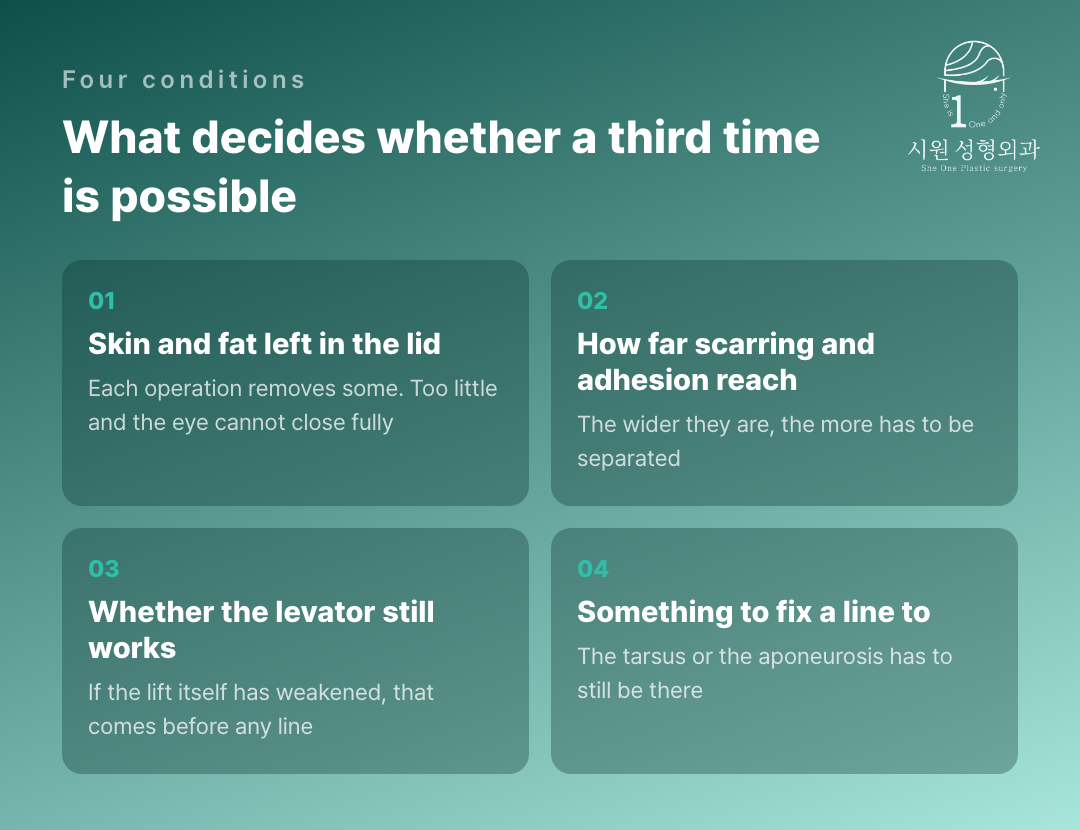
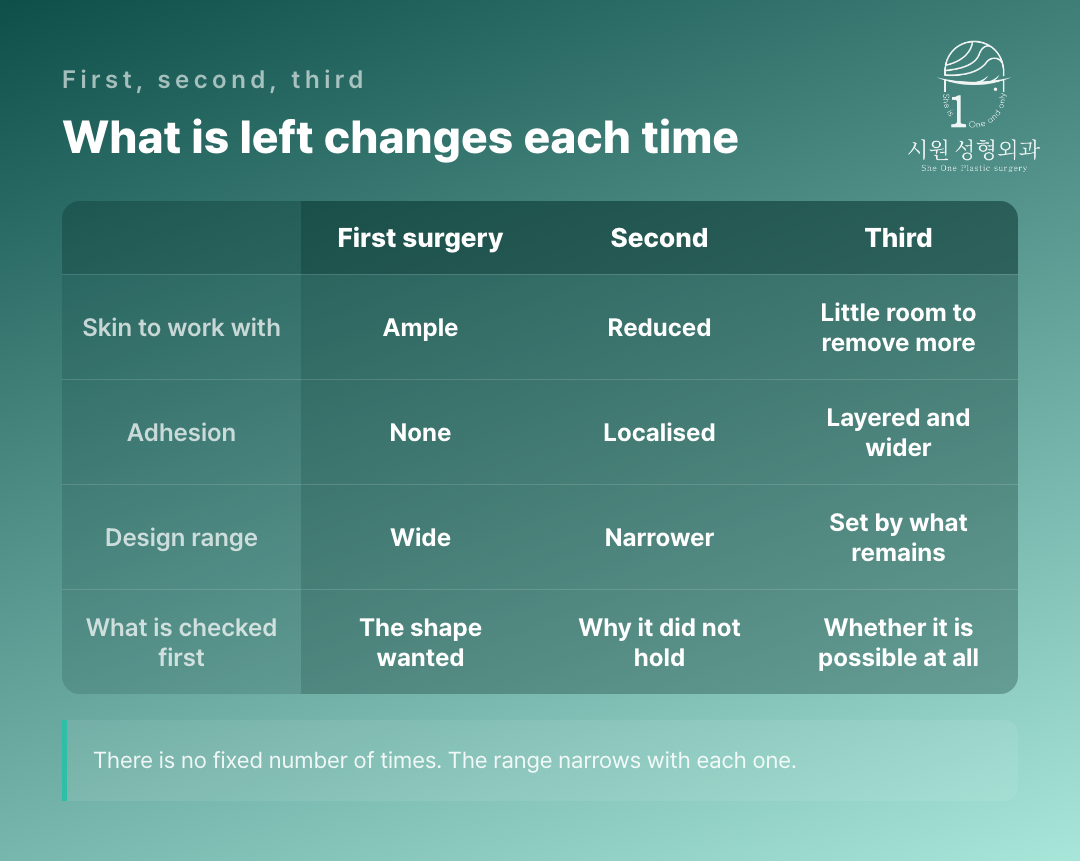
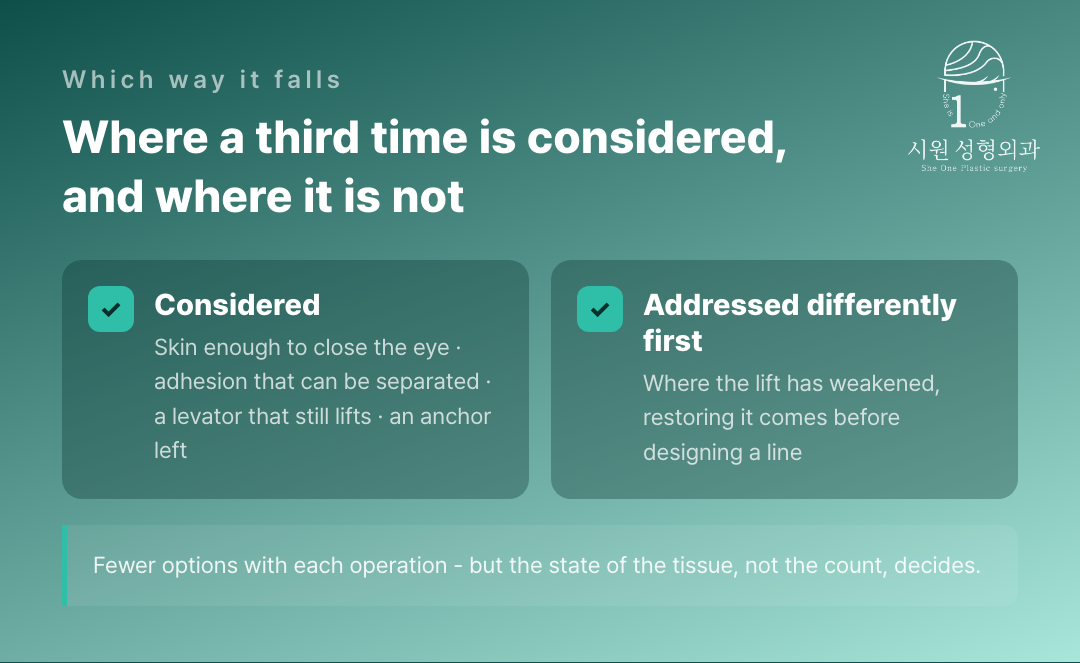
At a first surgery there is ample lid skin and fat, so the design has room. With each repeat the amount of skin already removed grows and the margin for removing more shrinks. Trying to lift a line higher with too little skin left can lead to lagophthalmos — the lid no longer covering the eye fully, which leaves it prone to drying — so how much skin remains is the first thing to gauge.
The second is how far scarring and adhesion reach. Where incision and closure have been repeated, tissue binds to itself, and the wider that adhesion the more has to be separated to place a line at all, with more bleeding and swelling to follow. Areas of thickened scar also tend to take longer for a new line to settle into.
The third is whether the levator — the muscle that produces the lift of the eyelid — is still working. Where repeated surgery has damaged or weakened the muscle and its aponeurosis, the lift itself drops and ptosis can remain; in that case restoring the lift comes before designing any line. How the levator aponeurosis is handled in eyelid surgery has been set out in the ophthalmic literature.
- How much lid skin and fat is left
- How far scarring and adhesion reach
- Whether the levator still works
- Whether tissue remains to fix a line to
What makes it possible anyway
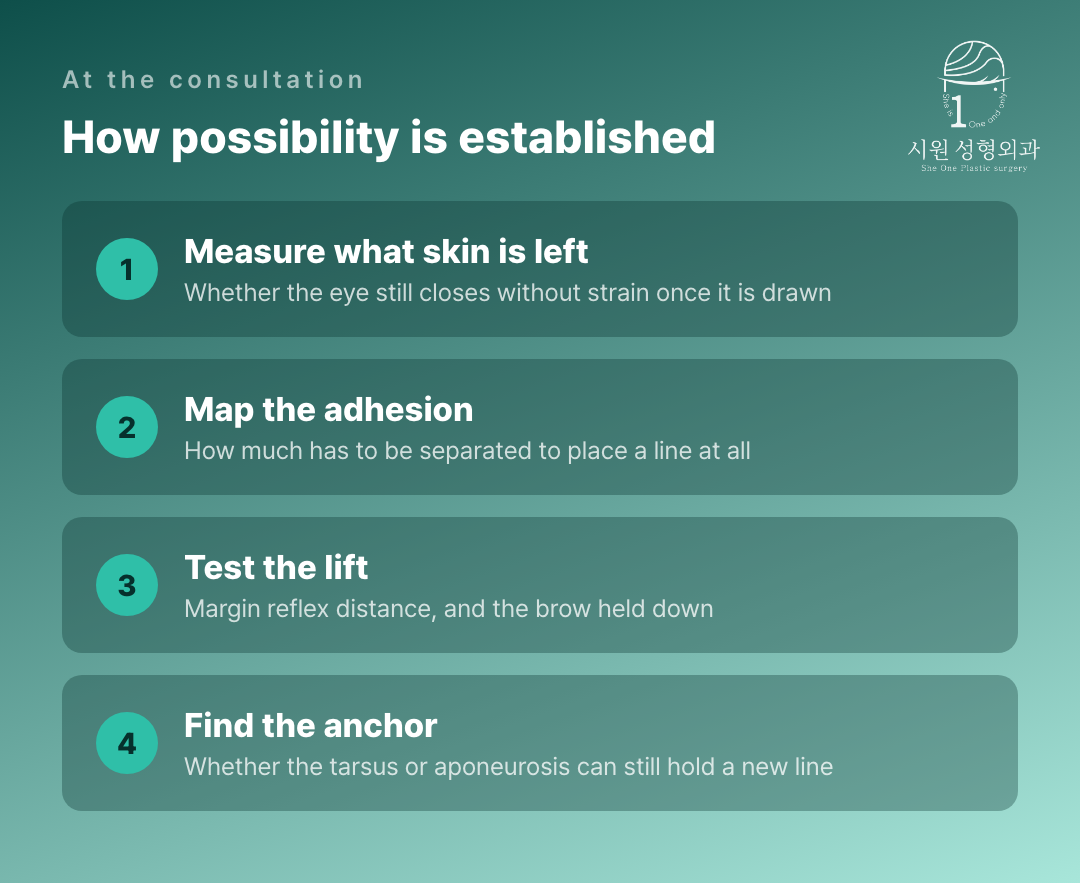
Only after establishing how much of those four remains can it be settled whether a third operation is possible, and by what approach. It follows that the skin is checked for whether the eye still closes without strain when drawn, and the adhesion of the existing line is separated to see whether the tarsus or the levator aponeurosis is still there to hold a new one.
A clinical study of revisional eyelid surgery in Asian patients reports a method that uses the levator aponeurosis as a bridge to correct ptosis and asymmetry together. Of 137 eyes, 81 (59.1 per cent) were classed as severe revisions; at the patient level 79.4 per cent reached an excellent aesthetic outcome and 8.8 per cent a good one, with no severe complications. That said, it is a method applied where levator function remains to some degree, and it does not transfer to every third revision.
The options narrow as the count rises, but depending on the state of what is left, a third operation can still be considered.
Questions worth settling before the consultation
Q1. Can a third be done with buried sutures?
Where adhesion and scarring are not extensive and enough subcutaneous tissue remains to hold a line, a buried technique is sometimes tried again. In most third operations, though, the adhesion has to be separated under direct view, so an incisional approach is usually considered alongside it.
Q2. How is a weakened levator checked?
By measuring how high the lid rises on an open eye — the margin reflex distance — or by holding the brow down and comparing the range between open and closed. If your eyes have tired easily since the second operation, or opening them takes more effort, that is worth raising at the consultation first.
Q3. If another clinic has declined, what should I ask?
Ask specifically what the refusal rested on — too little skin, the extent of adhesion, or a weakened levator. The same conclusion leads to different approaches depending on which it was, so asking for the reasoning against photographs or measurements helps. That the criteria differ by procedure is set out in what to establish when choosing a clinic for an eye revision.
Q4. How many revisions are possible?
There is no set number. But with each operation the remaining skin, tissue and levator function reduce, and the range of available methods reduces with them. Even with an opinion that a third is possible, it is worth holding in mind that the conditions narrow further at a fourth or fifth.
Recovery, and how this is approached here
A third operation adds the work of separating adhesion, so swelling and bruising tend to take longer to settle than after a standard crease surgery, and the line can need some months before it looks like your own. Where the levator has been addressed as well, there is a further period of watching the lift find its place.
Several operations and a refusal or two is a wearing sequence to have been through. A third is not recommended here as a matter of course. The remaining skin, the scarring and the levator function are read directly, and the range and its limits are set out together — what is actually left decides it, rather than a verdict that it can be done.
Individual recovery times and results vary, and side effects can occur. Please consult our medical team before making any surgical decision.
Patients from outside Korea
Consultations are held in English with the surgeon and our staff directly, not through an interpreter. Written enquiries in English are welcome.
WhatsApp ConsultationInternational patients welcome›
Official WebsiteProcedures and medical staff›
KakaoTalk ConsultationSend us photos and ask›
LINE ConsultationEasier if you are outside Korea›
DirectionsApgujeong Stn. · JJ Building 2F›
2F, JJ Building, 19 Apgujeong-ro 28-gil, Gangnam-gu, Seoul, Korea
Mon–Fri 10:00 – 19:00 · Sat 10:00 – 16:00 · (KST, UTC+9)
Closed Sun & public holidays · +82-2-512-1889
