
Will restoring it leave another scar?
Plenty of people hold off on a restoration for exactly this reason. It makes one more incision, and the worry is that trying to correct an existing scar leaves a line that shows more than the one you started with.
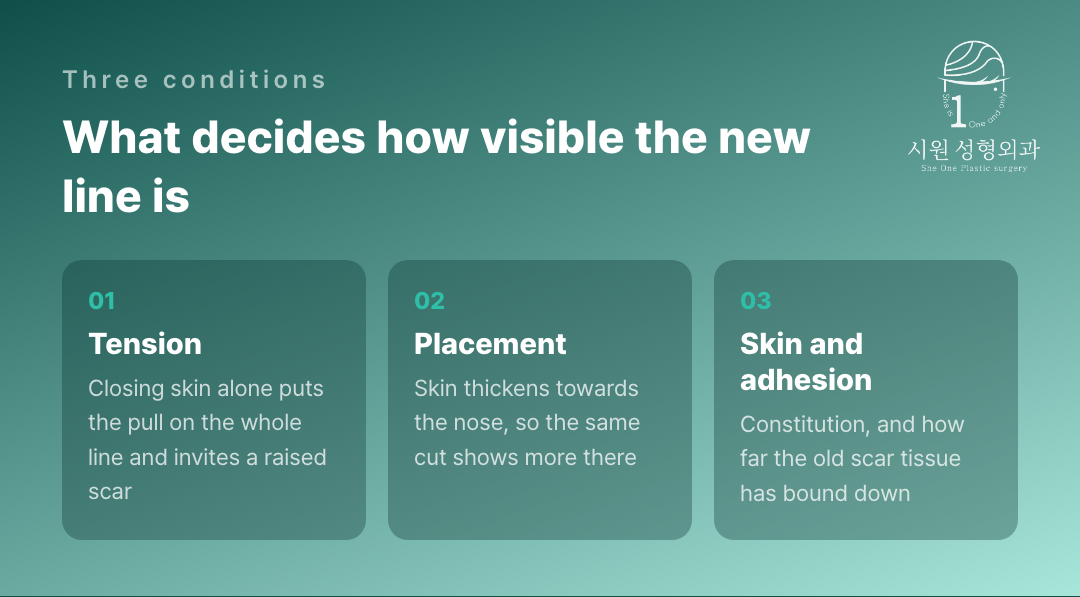
A restoration is not an excision of the visible scar. It is a matter of working through damaged skin, muscle and tissue that has bound to itself, and setting it out again. How the new line heals turns on three things — the tension pulling on it, where the incision is placed, and how your own skin answers a wound. Those three have to be separated before the operation, not after.
Three conditions that decide the scar
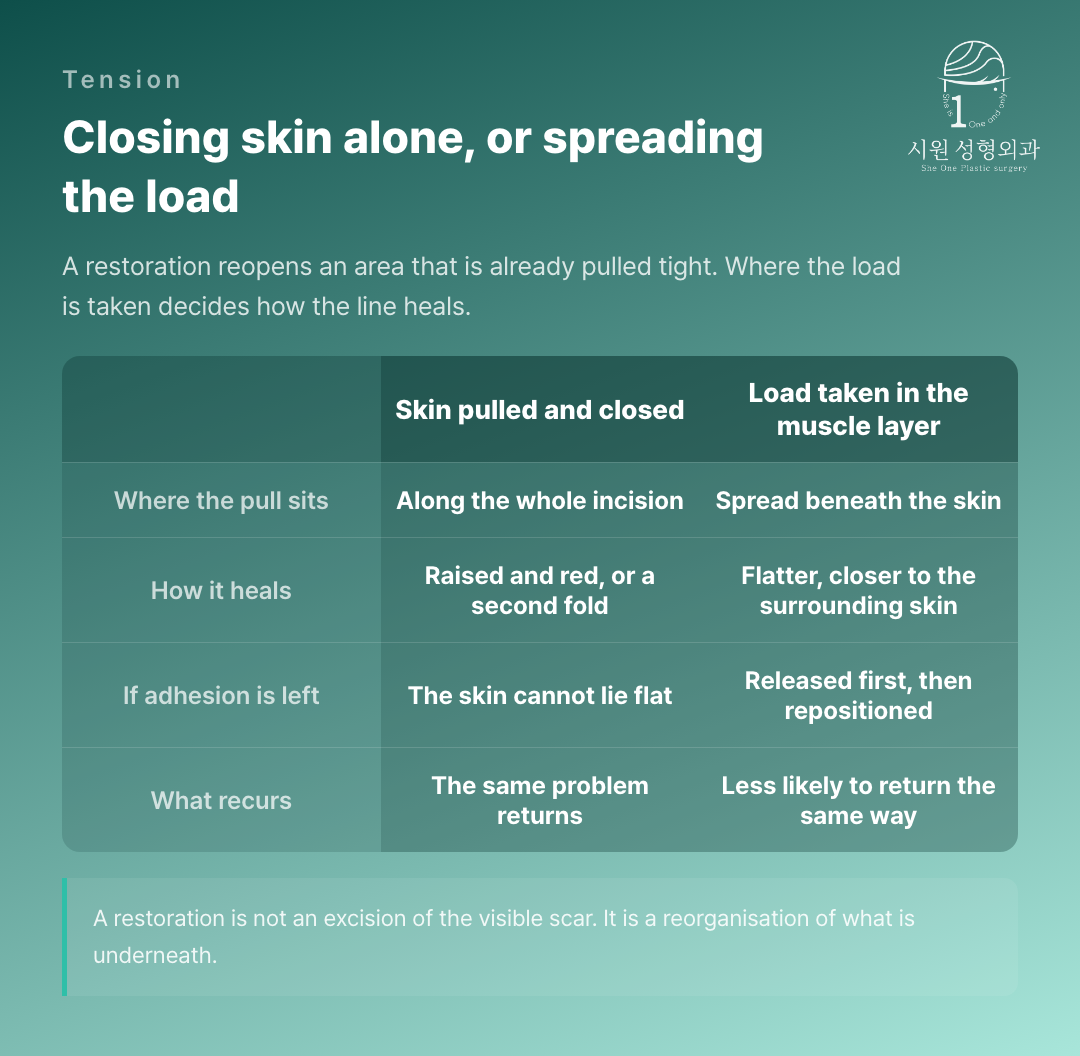
The first is tension. An inner-corner opening releases the fold of skin covering the corner of the eye; close the skin by pulling it and the whole line carries that pull. A restoration usually meets tissue around the old scar that has already set under tension, so closing skin alone invites the same raised, reddened scar or a second fold to form again.
The second is where the incision sits. Eyelid skin is thin, but it thickens towards the nose, and a scar shows more readily there. If a restoration moves the line further in than the existing one, the scar can end up larger — which is why using the line that is already there is generally the safer design.
The third is skin type and adhesion. A tendency to form raised scars is reported to carry a constitutional element, and tissue can react around the sutures holding the repair, leaving a thickened area you can feel. In most cases needing a restoration the old scar tissue has bound down beneath the skin; release it insufficiently and the skin cannot lie flat, so it settles back into a depression.
- Tension — closing skin alone puts the pull on the whole line and invites a raised scar
- Placement — skin thickens towards the nose, so the same cut shows more there
- Skin and adhesion — constitution, and how far the old tissue has bound down
The literature reports that lifting tissue widely to release adhesion can itself lead to raised scarring or a pulled deformity, and a method narrowing the excision to a triangle has been put forward to reduce that.
Designing so the scar stays small
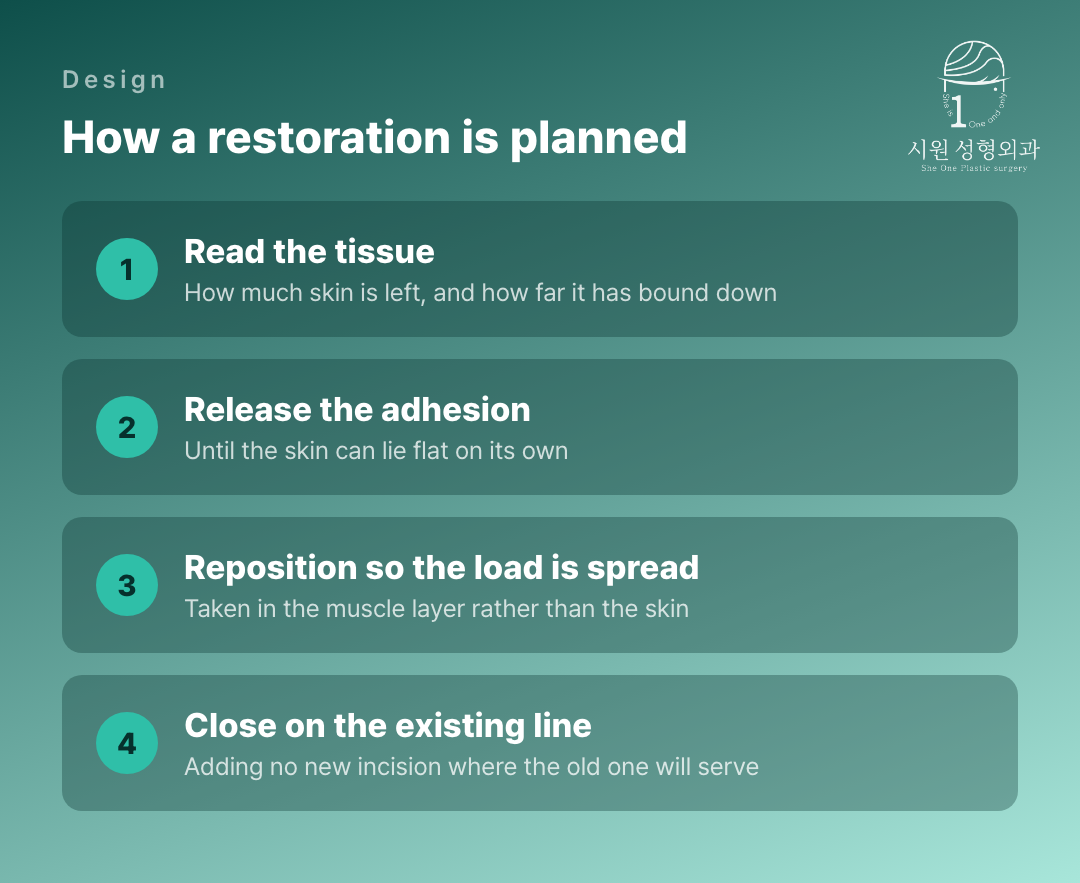
The point of a restoration is not to cut out what shows. It is to take those three conditions and build them into the plan in reverse. Use the existing line as far as it goes so no new incision is added; release the bound tissue thoroughly; then reposition so the muscle layer takes the load. The pull reaching the skin drops accordingly.
Which way it is designed depends on how much skin is left, the state of the tissue, and how far it has bound down. The literature reports a method correcting the fold without a vertical scar, a Z-shaped division that spreads the direction of pull, and a redraping approach that lifts the existing tissue minimally, each suited to a different state.
This is the same principle that decides whether a first opening reads as natural or obvious, and a restoration is approached on the same terms.
- Read the state of the tissue
- Release the adhesion
- Reposition so the load is spread
- Close with the smallest incision that will serve
Q1. A restoration is still a new incision — why would the scar be smaller?
A restoration usually reopens the line of the existing scar rather than adding one somewhere new. And unlike closing skin by pulling it, a design that also deals with muscle and bound tissue to reduce tension means that an incision of the same length is less likely to widen or stand out as it heals.
Q2. A white scar or a depressed one — which lasts longer after a restoration?
A white scar is colour that has not come back to the incision, and surgery alone does not restore it; separate treatment to help the skin regenerate is often added. A depression improves more readily, since releasing and repositioning the bound tissue addresses what caused it. Where both are present they are sometimes approached in stages.
Q3. If my skin scars badly, is a restoration pointless?
Constitution itself cannot be changed, but a design that reduces the tension on the line reduces how much that constitution shows. Whether you tend to form raised scars, and whether there was a reaction around sutures in a previous operation, are established at the consultation and built into the plan.
Q4. How many months before the new line settles?
Up to about a year for the line to soften fully. If six months pass with no change in colour or depth, though, that is a point to be seen again rather than to go on waiting for it to improve on its own.
How the line settles, month by month
From surgery through the first month there is swelling and the line carries a red tone. Around three months the redness subsides and the shape of the line starts to show. By six months it is reasonably clear whether it will fade further or stay as it is.
Where six months pass with no change in colour or depth, how to judge a scar that has not faded is set out separately.
By around a year the tissue around the line is more pliable and the sense of being pulled has usually eased. That is the point at which any further correction is judged.
A restoration is not an operation that erases a scar. It is an operation that decides how the new line will heal.
Holding off on a revision because the attempt to correct one scar might leave another is a reasonable place to stop. Nothing beyond what is needed is recommended here. The tension in the existing tissue, how far it has bound down, and how your skin answers a wound are read directly, and only a design the eye can take is put forward.
Individual recovery times and results vary, and side effects can occur. Please consult our medical team before making any surgical decision.
Patients from outside Korea
Consultations are held in English with the surgeon and our staff directly, not through an interpreter. Written enquiries in English are welcome.
WhatsApp ConsultationInternational patients welcome›
Official WebsiteProcedures and medical staff›
KakaoTalk ConsultationSend us photos and ask›
LINE ConsultationEasier if you are outside Korea›
DirectionsApgujeong Stn. · JJ Building 2F›
2F, JJ Building, 19 Apgujeong-ro 28-gil, Gangnam-gu, Seoul, Korea
Mon–Fri 10:00 – 19:00 · Sat 10:00 – 16:00 · (KST, UTC+9)
Closed Sun & public holidays · +82-2-512-1889
