
If the scar is unchanged after six months
A good while after an epicanthoplasty, a red mark, a white line or a dented trace can still sit at the inner corner and catch your eye in the mirror every time. If you have been caring for it in the expectation that it would soon fade, and half a year has brought no real change, it can be hard to know whether this is a scar to go on watching or one that calls for revision.
An inner-corner scar usually looks red and raised at first, as new tissue fills the incision and collagen rearranges itself, and then fades gradually with time. But that course varies a great deal between individuals, with the extent of the incision, the thickness of the skin and the tension in the suture. Being told that time will take care of it does not help you judge whether where you are now is within the normal range. A standard is needed for how long to watch, and from when to consider revision.
What follows looks at how an inner-corner scar changes around the six-month mark, and at how the timing of a revision can be judged.
Why some scars stay
Inner-corner scars fall broadly into two forms. In one, the melanocytes (the cells that make skin colour) at the incision do not recover properly and the colour drains to white — a hypopigmented scar. In the other, strong suture tension or an adhesion between the deeper layers pulls the skin inward so that it looks sunken — a depressed scar. Both are red and raised at first, and both take on their form more clearly as time passes.
Redness is at its most marked between one and three months after surgery, and fades gradually through three to six months. A scar can take from six months to close to a year to settle. Where the skin is thin, where the incision was wide, or where the scarring response is strong by constitution, a reddish tone can remain beyond a year. Through that period the tissue is often still reacting, and strong stimulation can make the scarring response larger rather than smaller.
Six months is one dividing point for gauging whether a scar is following the course of natural recovery.
How the timing of a revision is judged
It helps to look first at the stages a scar passes through according to its type.
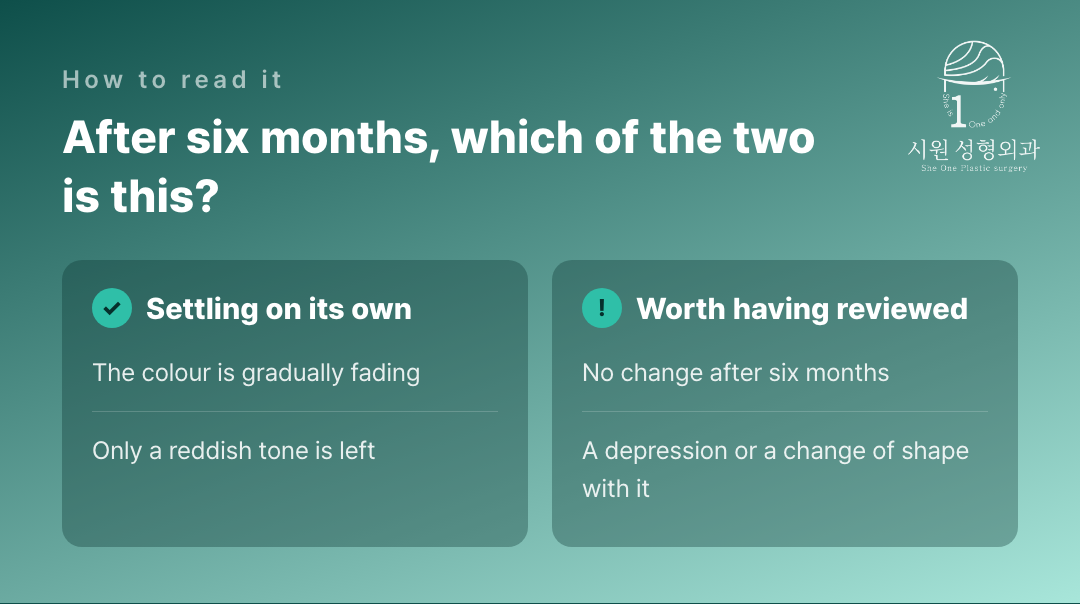
If the redness or the white mark is lightening even slightly by six months, the tissue can be taken as settling, and it is safer to go on watching a while longer. If, on the other hand, six months have passed with almost no change in colour or in the depth of the dent, the likelihood of further improvement on its own tends to fall.
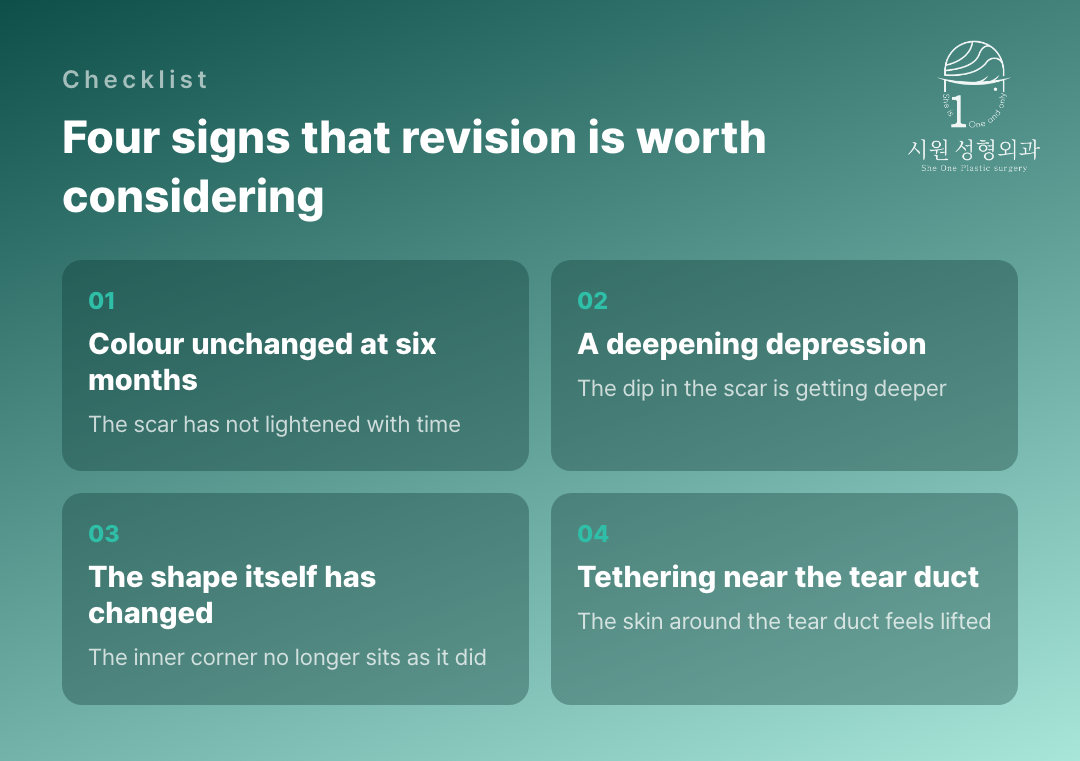
That standard cannot be applied to every scar as it stands. Where a depression has already set firmly, or the shape of the inner corner itself has changed and the skin around the tear duct feels lifted, identifying the cause is more useful than waiting longer.
A revision or a further correction is usually planned around the form a scar takes after it has stabilised rather than its early state. So the order is to establish which stage the present state belongs to.
Questions we are often asked
Will an inner-corner scar settle on its own if it is left alone?
Left to pass through a stable period without stimulation, it often does soften gradually, but this varies between individuals. How quickly the redness fades depends on skin type and on the method of incision, so at the same six months the scar that remains can differ from one person to the next.
Does a depressed scar fill in with time?
A depression that has already formed does not fill in by itself with the passing of time. An adhesion between tissues is often the cause, so an approach that releases it is considered alongside.
Do scar creams or massage help?
Basic care such as sun protection and keeping the wound clean can help prevent a scar from darkening. Massaging with strong pressure within the first six months, however, can enlarge the tissue response, and needs care.
Will revision surgery leave more scarring?
A revision also goes through a new incision and suture, so it is not that no scar forms at all. But where the design also addresses the causes of the existing scar — the adhesion, the pigment, the direction of the incision line — a less noticeable result than before can be expected.
The course by stage, and how we approach it
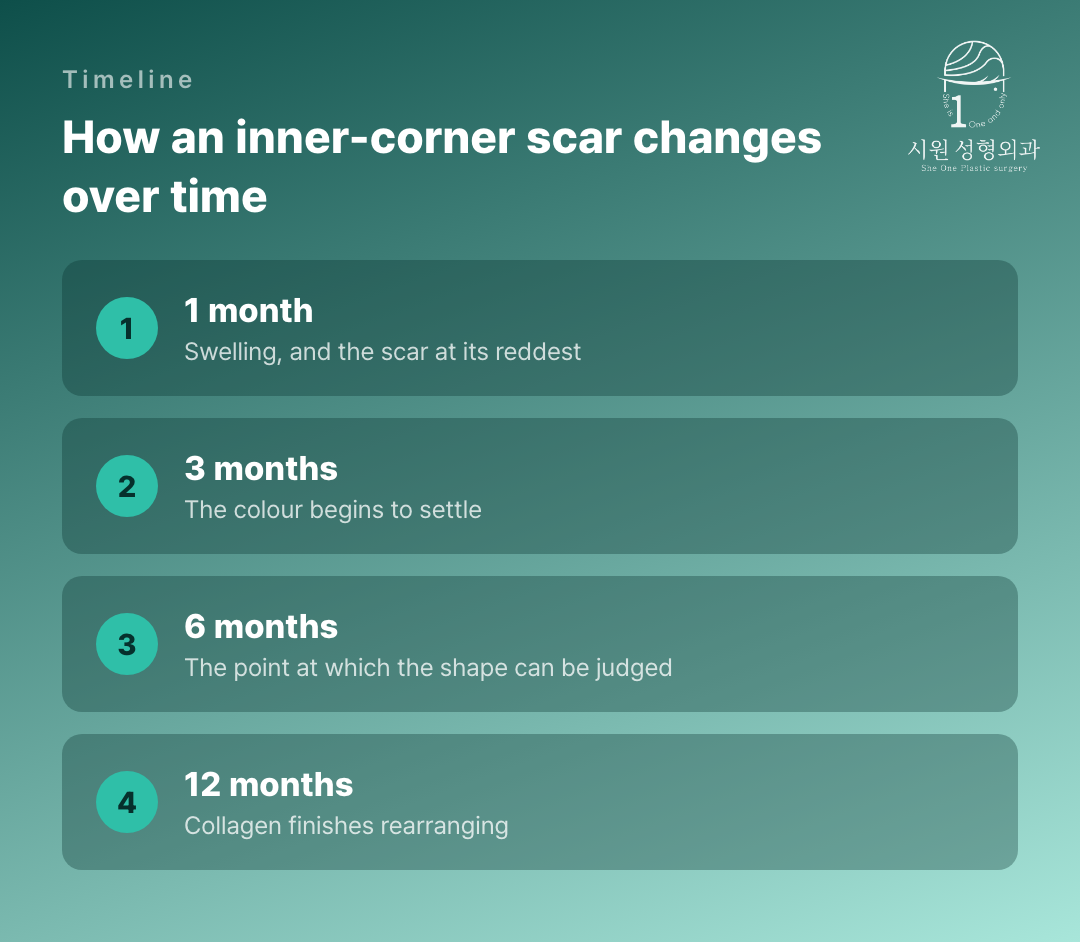
Set out by stage: up to a month after surgery the scar is at its reddest and most prominent, alongside the swelling. Through three months the colour begins to settle. Six months is the point at which the tissue response quietens and the form of the scar emerges. Up to a year, collagen continues to rearrange and the remaining redness can fade further. Where the course departs from this — no change after six months, or a clear depression or change of shape — revision can be considered from that point.
We understand the frustration of having cared for a scar in the belief that it would improve with waiting, only to find it still there.
We do not recommend revision beyond what is needed. Through a one-to-one consultation we assess the cause of the scar and the stage it has reached objectively, and propose a direction only within the scope that is genuinely required — so that you can tell whether this is a time to watch a little longer, or a time to consider a revision.
Individual recovery times and results vary, and side effects can occur. Please consult our medical team before making any surgical decision.
WhatsApp ConsultationInternational patients welcome›
Official WebsiteProcedures and medical staff›
KakaoTalk ConsultationSend us photos and ask›
LINE ConsultationEasier if you are outside Korea›
DirectionsApgujeong Stn. · JJ Building 2F›
Consultations are held in English with the surgeon and our staff directly, not through an interpreter. Written enquiries in English are welcome.
2F, JJ Building, 19 Apgujeong-ro 28-gil, Gangnam-gu, Seoul, Korea
Mon–Fri 10:00 – 19:00 · Sat 10:00 – 16:00 · (KST, UTC+9)
Closed Sun & public holidays · +82-2-512-1889
