
There are eyes that get larger from an opening alone
The question we are asked most often by patients in their twenties preparing for a first operation is whether an opening at the corners alone can make the eyes larger. Have you tried pulling the outer corner gently with a fingertip in front of the mirror, to gauge the change in advance?
A corner opening moves the border between the skin and the mucosa that covers the eye, widening the area of eye that shows. It is not an operation that enlarges the eye itself. So even when the same extent is opened, an eye that is only short horizontally and an eye that is narrow vertically as well will give different results. That is decided by the proportions the eye already has rather than by how much is incised, which is why a structural assessment before surgery is required.
What follows looks at which eyes a first corner opening suits, and at the standard by which a scope that is not excessive is designed.
Opening horizontally and opening vertically have different aims
Where double-eyelid surgery opens the eye upward and downward to gain height, a corner opening moves the left and right borders to gain length. The same eye is being worked on, but the axis that moves is different, so what is needed depends on which of the two is lacking now. A report on canthoplasty in a plastic surgery journal likewise separates double-eyelid surgery, which changes the vertical dimension of the eye, from inner and outer corner openings, which change the horizontal.
For an eye that is short only horizontally and has enough height, an inner and outer opening alone can be expected to change the impression. But in an eye with a thick lid and limited height as well, widening only horizontally can tend toward a long, narrow look, so whether to plan a crease alongside has to be judged first. A report in an ophthalmology journal on the course and satisfaction after an epicanthoplasty combined with double-eyelid surgery also addresses that kind of combined plan.
An opening does not make an eye newly large. It reveals an eye that was covered.
Even with the same inner-corner opening, the result divides with the thickness of the fold and the tension of the skin.
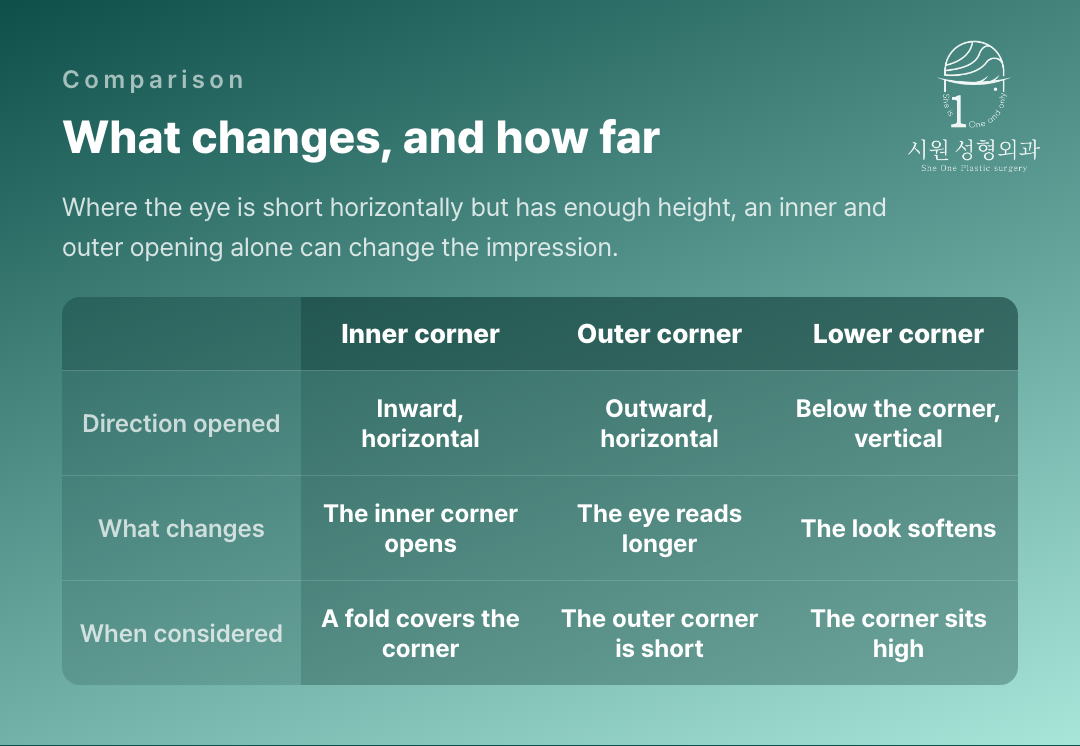
The direction each of the three opens
An inner-corner opening tidies the fold that covers the inside of the eye and opens the inner corner. It is considered where the covered corner makes the eyes look far apart or gives a heavy impression, and the balance with the distance between the eyes has to be looked at together so the result does not read as odd.
An outer-corner opening opens the lateral canthus on the outside of the eye and widens it horizontally. How much room is left beyond the outer corner — that is, the distance between the eye and the outer orbital bone — governs the result, so measurement comes first.
A lower-corner opening brings the outer corner downward and adjusts the angle of the eye. It is reviewed together in eyes whose outer end rises so that the impression reads cold, and designing it as a pair with an outer-corner opening often settles the proportions naturally.
Why the scope is kept narrow, especially at a first operation
The result of a corner opening is not decided by the length of the incision. What makes the result is judging first how far this particular eye allows, and setting the direction within that. Incising past the permissible line in the wish for larger eyes leaves mucosa showing, or a scar standing out along the incision. A craniofacial surgery report covering 421 epicanthoplasties notes that dissecting more widely than necessary can leave a hypertrophic scar or a web-shaped deformity. Why an epicanthoplasty revision falls short covers the causes in more detail.
An eye widened only from side to side can read as harsher instead, or show white at the sides of the iris and below it at once. Undoing a width once opened is far more demanding than opening it in the first place, so the more conservatively a first operation is approached, the lighter the burden afterwards. Correcting the unnatural result of a previous epicanthoplasty is reported in the literature as a separate procedure in its own right — undoing is a field of its own.
She One Plastic Surgery practises eye surgery only, without operations on other parts of the body, and handles inner, outer and lower corner openings as well as revision of them. What we have confirmed through taking on the undoing again and again is that the margin left at the start is what protects the choices available later. For that reason a design that is sparing with width is our default at a first operation.
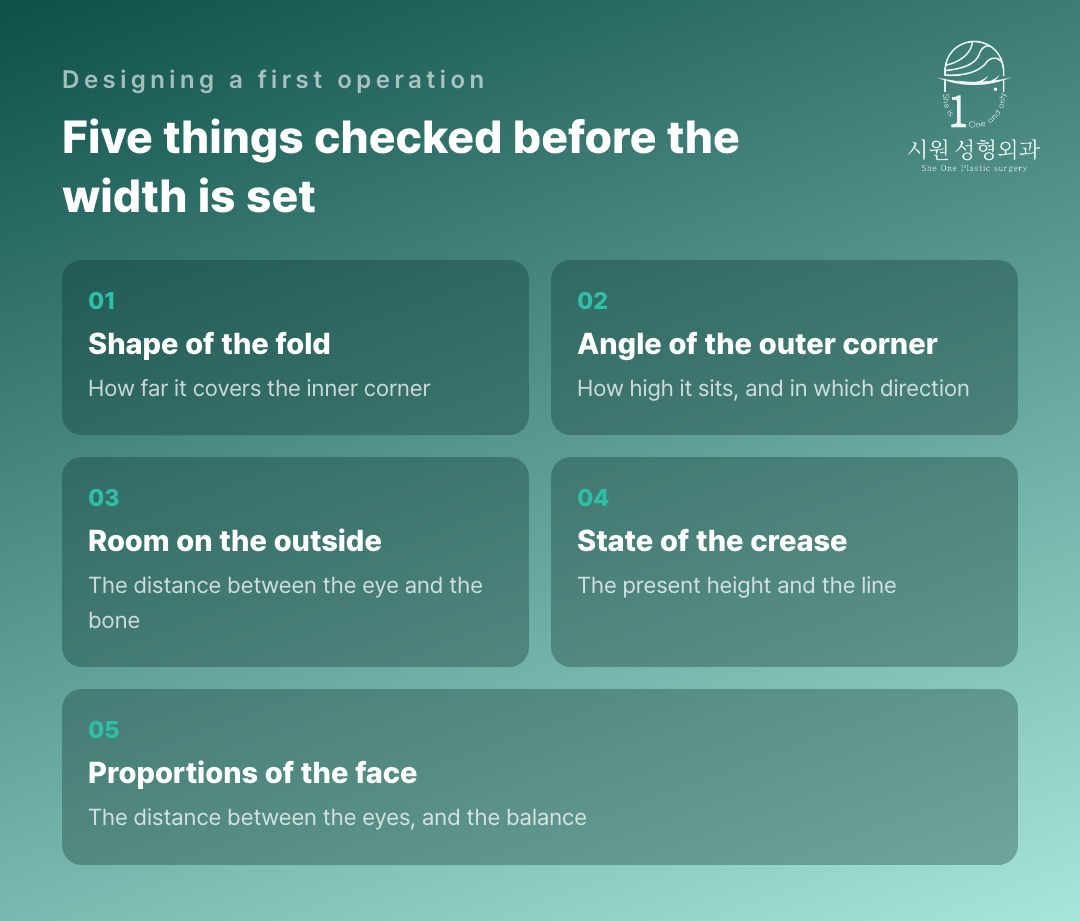
What to check before a consultation
The items below set out what is actually checked in consultation, so that you can look them over in advance. If any apply to you, mentioning them first at the consultation makes the measurement quicker.
- The fold inside the eye is marked and the inner corner is covered — an inner-corner opening can be reviewed.
- The outer corner is short and the whole eye looks narrow — an outer-corner opening can be reviewed.
- The outer corner rises so that the impression reads cold — a lower-corner opening is looked at alongside.
- The distance between the eye and the outer bone is not generous — the width of an outer-corner opening may be limited.
- Widening only horizontally seems likely to sharpen the look — whether to combine a lower-corner opening is reviewed together.
- A date is being set before adequate measurement — reversing that order is safer.
Re-adhesion, in which an opened area joins again during recovery, is not rare. The tissue that causes the adhesion has to be cleared sufficiently during surgery, and following the course through recovery also affects the result.
Questions we are often asked
Will an opening alone change the impression?
Where the eye is on the short side horizontally, many people do feel a change from an opening alone. But in an eye that is narrow vertically as well, an opening by itself can fall short of expectations, so it is safer to measure first and then decide whether to plan a crease alongside.
Is it all right to choose only one of the inner and outer openings?
Some patients do have just one. An inner-corner opening carries meaning for an eye with a marked fold over the corner, and an outer-corner opening for an eye short on outer length, so it is difficult to decide in advance which is better. That said, in some eyes opening only one side leaves the balance looking odd, so we recommend deciding with the whole proportion in view.
Doesn’t opening wider make the eye correspondingly larger?
An incision past the permissible line leaves mucosa showing or a scar standing out, and can come back as the opened area joining again. An eye widened only from side to side can read as harsh, or show white on three sides, which is why a design sparing with width is called for the earlier the operation is.
What if the opened area joins again?
Where re-adhesion is confirmed, the degree and the timing are looked at first, because the response differs depending on whether it is a temporary change early in recovery or the structure having returned. Where restoration is needed, planning it from the point at which the tissue has stabilised is usual. How an inner-corner scar is judged when it is still there at six months sets out that standard.
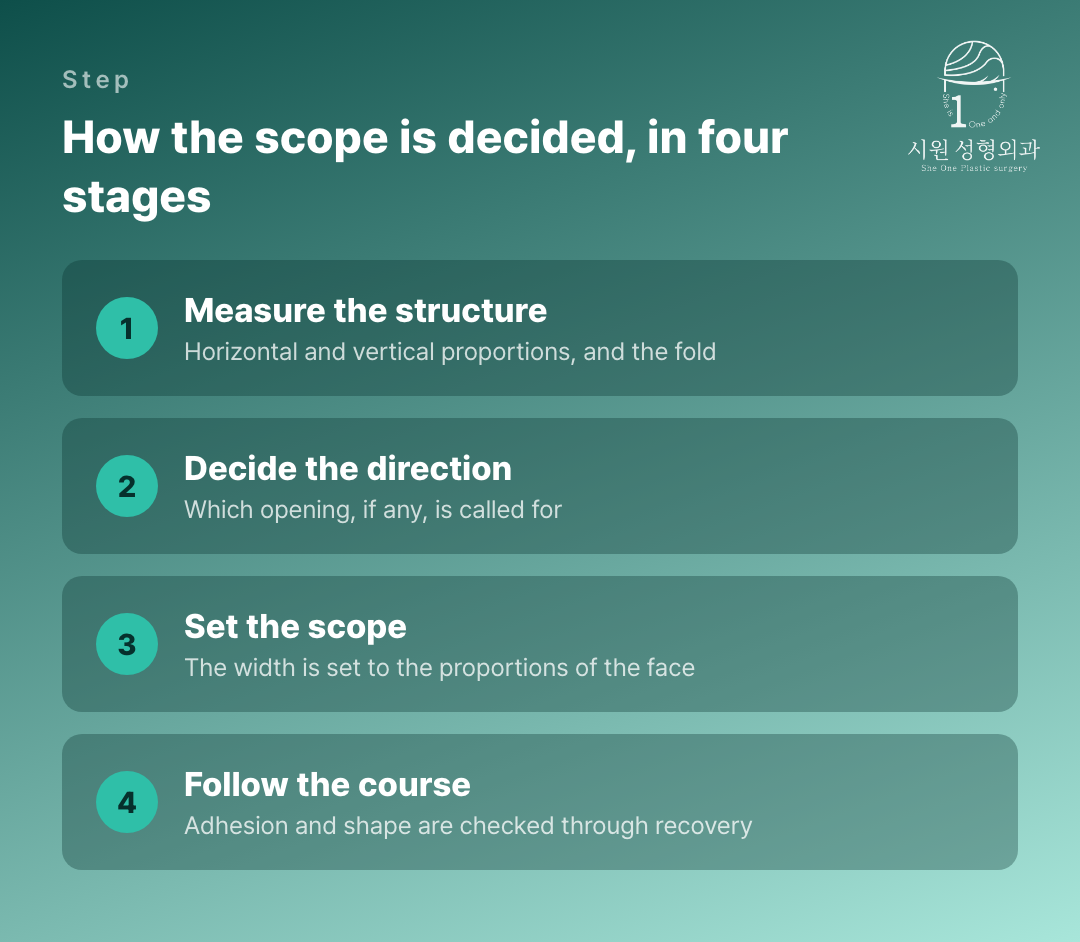
Our standard for an eye that is not overdone
In short, a first corner opening succeeds or fails on direction and scope, not on width. Whether the eye is short horizontally, whether it is narrow vertically as well, whether room remains beyond the outer corner — only after those are established does an answer emerge as to which opening is needed.
We understand how long patients hesitate at a first operation, not knowing what to decide by.
We do not recommend an opening of excessive scope. Through a one-to-one assessment we analyse the proportions of the eye and the structures around it objectively, and propose only the direction this eye can take without strain — so that a first operation does not become a burden later.
Individual recovery times and results vary, and side effects can occur. Please consult our medical team before making any surgical decision.
WhatsApp ConsultationInternational patients welcome›
Official WebsiteProcedures and medical staff›
KakaoTalk ConsultationSend us photos and ask›
LINE ConsultationEasier if you are outside Korea›
DirectionsApgujeong Stn. · JJ Building 2F›
Consultations are held in English with the surgeon and our staff directly, not through an interpreter. Written enquiries in English are welcome.
2F, JJ Building, 19 Apgujeong-ro 28-gil, Gangnam-gu, Seoul, Korea
Mon–Fri 10:00 – 19:00 · Sat 10:00 – 16:00 · (KST, UTC+9)
Closed Sun & public holidays · +82-2-512-1889
