
Bruising and swelling after an epicanthoplasty revision, from day 7 to a settled scar
You have probably come to this page wondering when the swelling after an epicanthoplasty revision goes down. If you have decided on a revision to correct a scar or an unnatural shape left by an earlier epicanthoplasty, the recovery period weighs as heavily as the operation itself.
For anyone who has to get back to work or to classes quickly, how long the swelling lasts becomes a decisive factor in scheduling surgery.
She One Plastic Surgery understands the weight carried by patients who have spent a long time distressed by the result of eye surgery, and sets out accurate, objective information so that the anxiety of the recovery period is a little lighter.
What follows looks, from day 7 — the point at which sutures come out — at how bruising and swelling change, and at the course through which the scar settles.
Why bruising and swelling occur
As in any surgical procedure, an epicanthoplasty revision necessarily involves bleeding from capillaries and handling of the soft tissue. What we see as bruising and swelling is the result of the body’s natural physiological response as that tissue heals.
That said, an epicanthoplasty revision is confined to a local area, unlike eye surgery that incises across the whole lid (an incisional double-eyelid operation, for example). Compared with surgery that works on bone or on a wide area of muscle, blood loss is smaller and the surrounding tissue is disturbed less, so marked bruising and severe swelling occur relatively less often.
The timeline, stage by stage
Recovery speed varies with the thickness of the skin, the tissue type and how readily bleeding stops, but in general the course runs as follows.
- Surgery to day 7 (when the sutures come out) — the first week is the period of acute swelling. By day 7, when the sutures are removed, the worst of it begins to subside, but yellow or bluish bruising can still remain around the incision.
- Around week 3 (the visible bruising and swelling ease) — the noticeable bruising and swelling are generally absorbed and gone over about three weeks. From this point it can usually be covered lightly with make-up, and daily life is not much affected.
- Months 1 to 2 (the scar reacts) — once the surface has healed, the soft tissue beneath knits together, and through the first and second month the site can temporarily feel firm, bunched or tight. This is an entirely normal part of healing.
- From month 2 onward (the tissue relaxes) — from around the second month, the scar tissue that has been held taut begins to relax. The firmness at the inner corner softens, and the carefully repositioned flap settles in as the patient’s own tissue.
Slight bruising and swelling can remain depending on the individual, and subside gradually with time. (Photographs of the actual course in a range of patient cases can be seen through the Naver blog link below.)
Precision in theatre governs the length of recovery
Narrow though the field is, an epicanthoplasty revision calls for a high degree of precision: separating abnormally adherent scar tissue delicately, then reassembling the internal structure. How far unnecessary tissue damage is avoided during the operation makes a considerable difference to the amount of bruising and swelling afterwards, and to the overall length of recovery.
We do not press anyone toward surgery. Through a one-to-one assessment by the director, the depth of the scar and the anatomy of each patient are analysed precisely. With an approach that is safe and honest about reducing tissue damage, we aim to see patients through recovery as comfortably as possible and back to their ordinary days.
If you would like to know the scope of surgery and the likely recovery period for your own eye, you are welcome to come in for an assessment at any time.
What the recovery actually looks like
A case from our official Naver blog. The course can be followed in photographs.
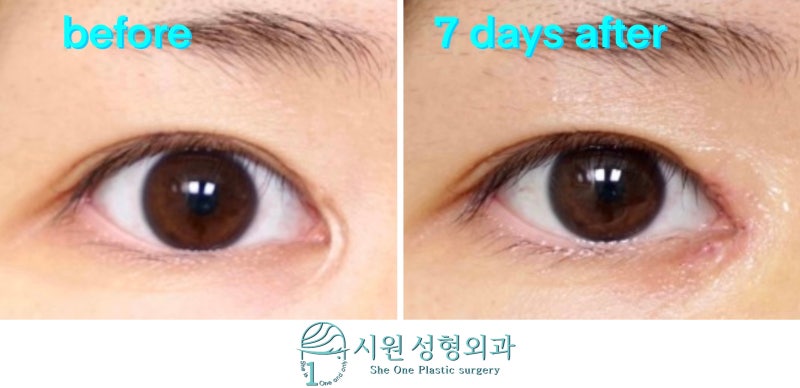
The before and after photos in this post are published with the patient’s consent.
When the bruising and swelling are at their worst — day 7, sutures just out ›
Even after the same operation, the bruising and swelling differ a great deal from patient to patient. Photographs of many more day-7 cases than could be shown here are on our official Naver blog.
The before and after photos featured in this post are shared with the patient’s explicit consent in accordance with the Medical Service Act. Individual recovery times and results vary, and side effects can occur. Please consult our medical team before making any surgical decision.
WhatsApp ConsultationInternational patients welcome›
Official WebsiteProcedures and medical staff›
KakaoTalk ConsultationSend us photos and ask›
LINE ConsultationEasier if you are outside Korea›
DirectionsApgujeong Stn. · JJ Building 2F›
Consultations are held in English with the surgeon and our staff directly, not through an interpreter. Written enquiries in English are welcome.
2F, JJ Building, 19 Apgujeong-ro 28-gil, Gangnam-gu, Seoul, Korea
Mon–Fri 10:00 – 19:00 · Sat 10:00 – 16:00 · (KST, UTC+9)
Closed Sun & public holidays · +82-2-512-1889
