
When is lower eyelid fat repositioning enough on its own?
Most people who look into lower eyelid fat repositioning come in having been told that the area under the eye bulges and casts a shadow that makes them look tired. The question in consultation is usually whether this one procedure settles it — and the answer does not come from looking at the lower lid alone.
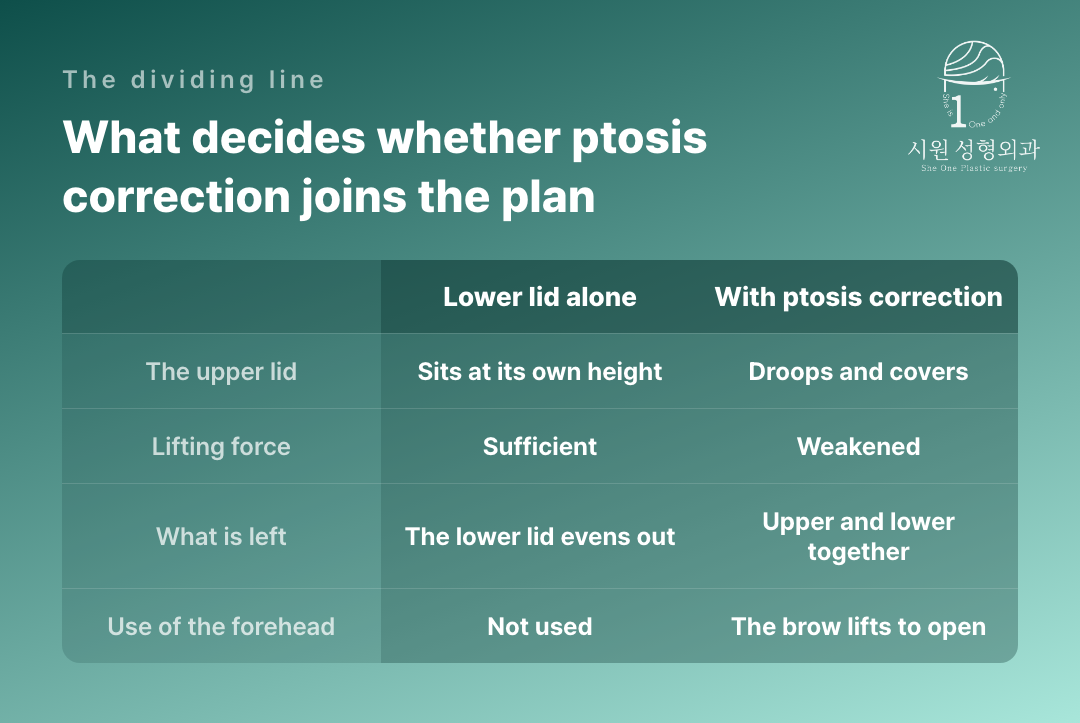
If the fullness under the eye is a matter of where the fat sits, and the upper lid is holding its own height, fat repositioning on its own often settles it. But where the upper lid has dropped and the force that opens the eye has weakened, evening out the lower lid leaves the tired impression exactly as it was.
What follows sets out how the two cases divide — when fat repositioning can be planned on its own, and when ptosis correction has to be looked at with it.
Why does a tear trough form, and why does the lower lid bulge?
When the fat that cushions the eyeball pushes forward, the area below the eye becomes convex. Just beneath it runs a ligament that holds the skin down toward the bone, and a groove forms at that border. That groove is the shadow seen as a tear trough.
So removing fat alone does not make the border disappear. A plastic surgery report on releasing the tear trough ligament and moving fat down into the hollow beneath it sets out the course in 54 patients, approached through the inside of the lower lid and extending into the area below the lid.
The course we see follows the same principle. This is not an operation that takes fat away but one that moves and fills with it, and that changes what recovery looks like too. The course of lower eyelid fat repositioning, stage by stage covers that separately.
Fat that has been moved takes time to settle. Early on it looks even because of the swelling, and the contour emerges over several weeks, so it is better not to judge the result by how it looks in that period.
Does a tear trough ever call for lower blepharoplasty?
The same tear trough divides into three causes, and what is needed divides with them. From outside they look like a similar shadow; inside, different things are happening.
First, fat that has pushed forward. The area below the eye is convex with a groove beneath it, and fat repositioning — moving the protruding fat down into the hollow — is at the centre. This is the most common case among people who come in considering the procedure.
Second, little fat but a hollow. There is no convexity, only a deep groove. Where there is not enough fat to move across, filling with fat from elsewhere or with another material is considered alongside. Planning repositioning alone here leaves too little to fill with, and the groove does not smooth out as hoped.
Third, skin that has loosened. The skin below the eye folds and fine lines gather with it. Moving fat leaves the loosened skin where it is, so a lower blepharoplasty — tidying the skin and muscle of the lower lid — is looked at together.
The three are rarely separated as cleanly as that; more often they are mixed. Which is the main cause changes the plan for the same tear trough, so the order has to be to look at the eye first and name the procedure after — not to settle on a name and fit the eye to it.
Which eyes need ptosis correction looked at as well?
Where the upper lid covers a good deal of the iris, and the forehead is recruited or the brow rises when the eye opens, the strength of the muscle that opens the eye is assessed too. In that state, evening out the area below the eye does not change the overall impression much.
A plastic surgery report on correcting upper eyelid ptosis in East Asian patients describes this as technically demanding both at a first operation and at a revision. That is why it is better to settle in advance whether the two are combined or divided.
Where the outer corner has dropped as well, or the two sides sit at different heights, the scope widens. Correcting a difference between the two sides after double-eyelid surgery follows the same line of judgement.
Does a drooping upper lid change the result below?
It does. Where the lifting force is weak the opening of the eye looks narrow, and smoothing only the area beneath it makes the imbalance between upper and lower more noticeable rather than less. That is the case in which people say the under-eye is tidy but the face still looks tired.
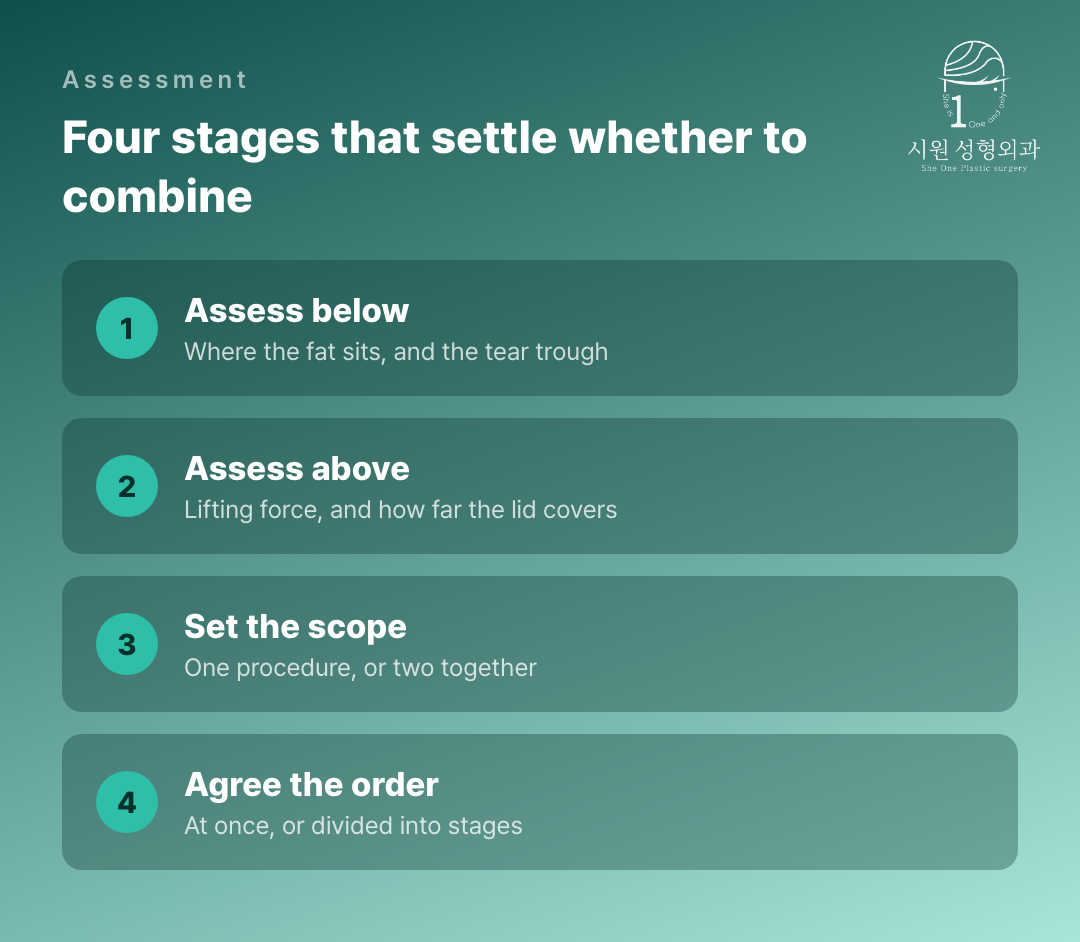
Conversely, correcting the upper lid first opens the eye and can make the fullness below more apparent. Which to do first, or whether to do both, is decided after measuring the two together in one sitting.
Whether the change came with age or was there in the original structure is looked at too. Fullness below the eye already present at a young age points less to the amount of fat than to a weak membrane holding it, and in that case less is taken away.
What does recovery look like if both are done?
Doing both does not double the recovery, but swelling subsides and becomes noticeable on a different schedule in each area. Above, the crease takes time to settle; below, the moved fat follows its own course toward stability.
Dividing them is also an option. Where the conditions are hard to carry in one operation, or where one side of the judgement needs watching longer, putting them in order is safer. What is done at once and what is divided is decided from the present state.
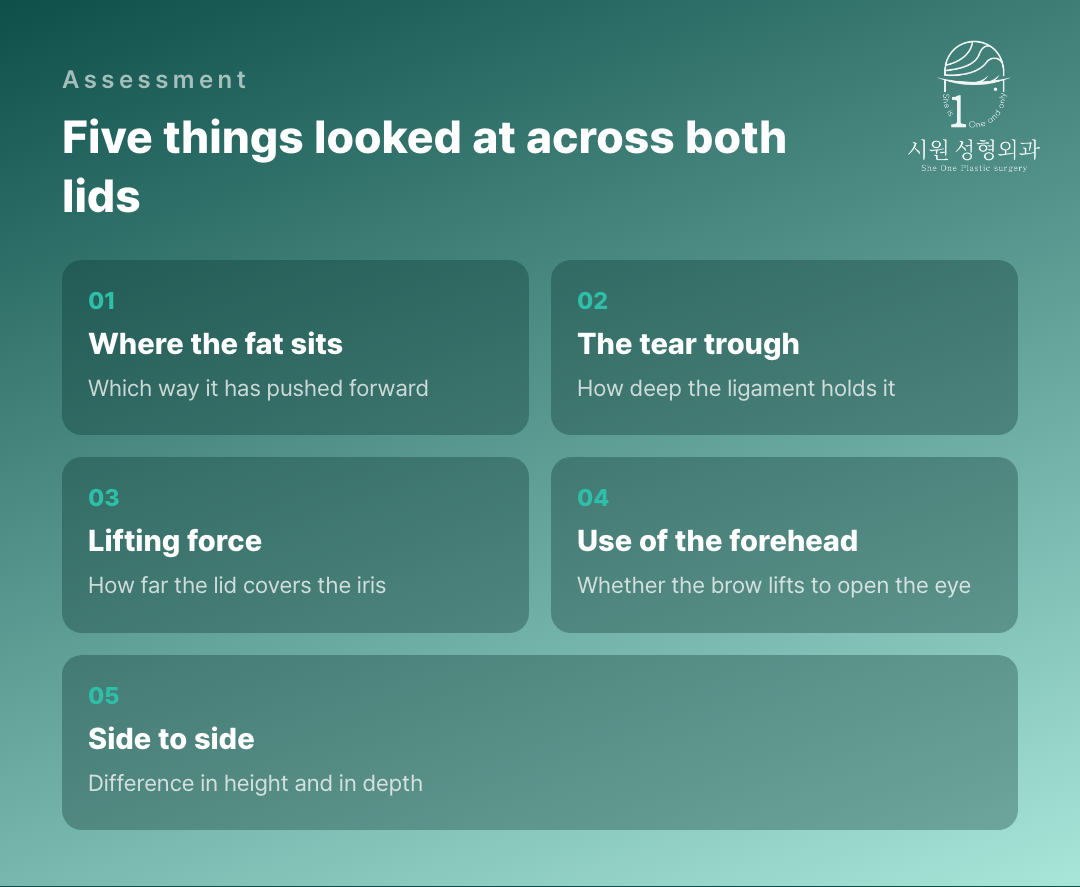
- Whether the fullness below the eye is from fat or from loosened skin
- Whether the groove of the tear trough comes from the ligament or from a hollow
- How far the upper lid covers the iris
- Whether the forehead or the brow rises when the eye opens
- How far the two sides differ in height and in depth
What to establish in consultation
Rather than comparing the names of procedures, it helps to ask whether the assessment looked only below the eye or took in the upper lid as well.
The difference between a practice that handles only eyes and one that handles many areas is not a matter of skill but of how far is measured in one sitting. Around the eye, upper and lower influence one another, and a plan built from the lower lid alone can come out wrong because of what is happening above.
So look for whether these are checked together: whether the tear trough comes from protruding fat, from a hollow or from loosened skin; how far the upper lid covers the iris; whether the forehead or brow rises on opening; and how far the two sides differ in depth and height. Where those values are measured in one sitting and the plan is explained from them, the consultation has grounds behind it.
If a procedure is named after looking only below the eye, it is worth asking once more. People who keep being told they look tired after the under-eye was tidied usually started from an assessment that did not take in the upper lid.
Where the under-eye is already tidy and the comment has not changed, the part that was not measured is usually above it. Eye surgery is the only thing this clinic does, which means the upper and lower lid are measured in the same sitting as a matter of course rather than as an extra step. If the measurements say one procedure is enough, that is what we will say — and if they say the order matters, we will explain the order before anything is decided.
Individual recovery times and results vary, and side effects can occur. Please consult our medical team before making any surgical decision.
WhatsApp ConsultationInternational patients welcome›
Official WebsiteProcedures and medical staff›
KakaoTalk ConsultationSend us photos and ask›
LINE ConsultationEasier if you are outside Korea›
DirectionsApgujeong Stn. · JJ Building 2F›
Consultations are held in English with the surgeon and our staff directly, not through an interpreter. Written enquiries in English are welcome.
2F, JJ Building, 19 Apgujeong-ro 28-gil, Gangnam-gu, Seoul, Korea
Mon–Fri 10:00 – 19:00 · Sat 10:00 – 16:00 · (KST, UTC+9)
Closed Sun & public holidays · +82-2-512-1889
