
Why does a raised scar form at the inner corner?
You have probably come here wondering when a raised scar at the inner corner finally softens. When the site still feels thick under a fingertip and carries a reddish tone week after week, it is natural to start worrying that it will set that way.
A raised scar forms when more collagen is laid down than is needed as the wound heals. The inner corner is pulled every time the eye opens and closes, so load stays on the suture line, and that load acts as a signal to make more collagen. In other words, a raised scar is not a sign that healing has stalled — it is closer to a sign of a period in which healing is unusually active.
What follows sets out how a raised inner-corner scar changes stage by stage, and how the course differs by type.
When does it start to soften?
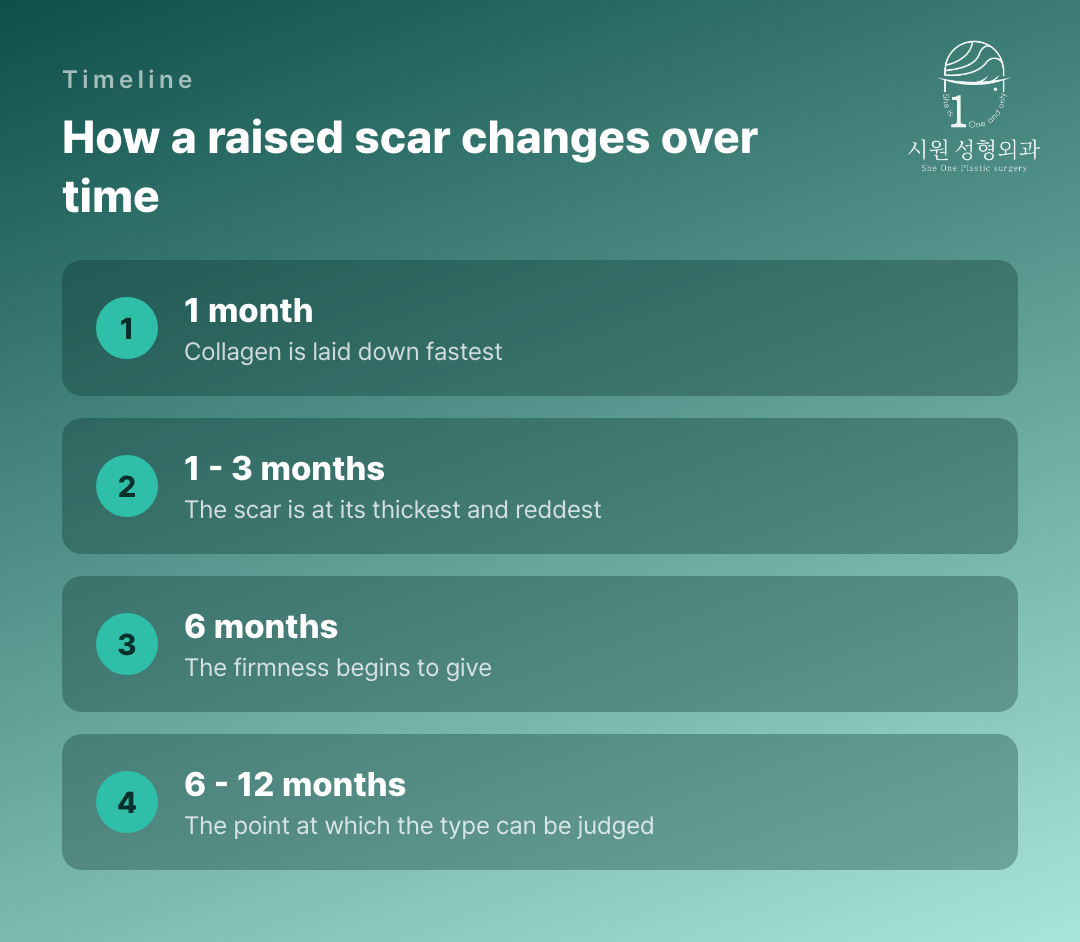
A raised scar generally looks thickest between one and three months after surgery. Past that period the newly laid collagen begins to be tidied away, and the firmness felt under a fingertip gives little by little.
The pace differs between people. The thicker the skin and the stronger the pull, the longer the load stays on the suture line, and the later the softening comes. That is why two people who had the same operation can be on different courses.
How long before the redness fades?
Redness is new microvessels within the scar showing through. As the tissue stabilises and those vessels reduce, the colour settles with them.
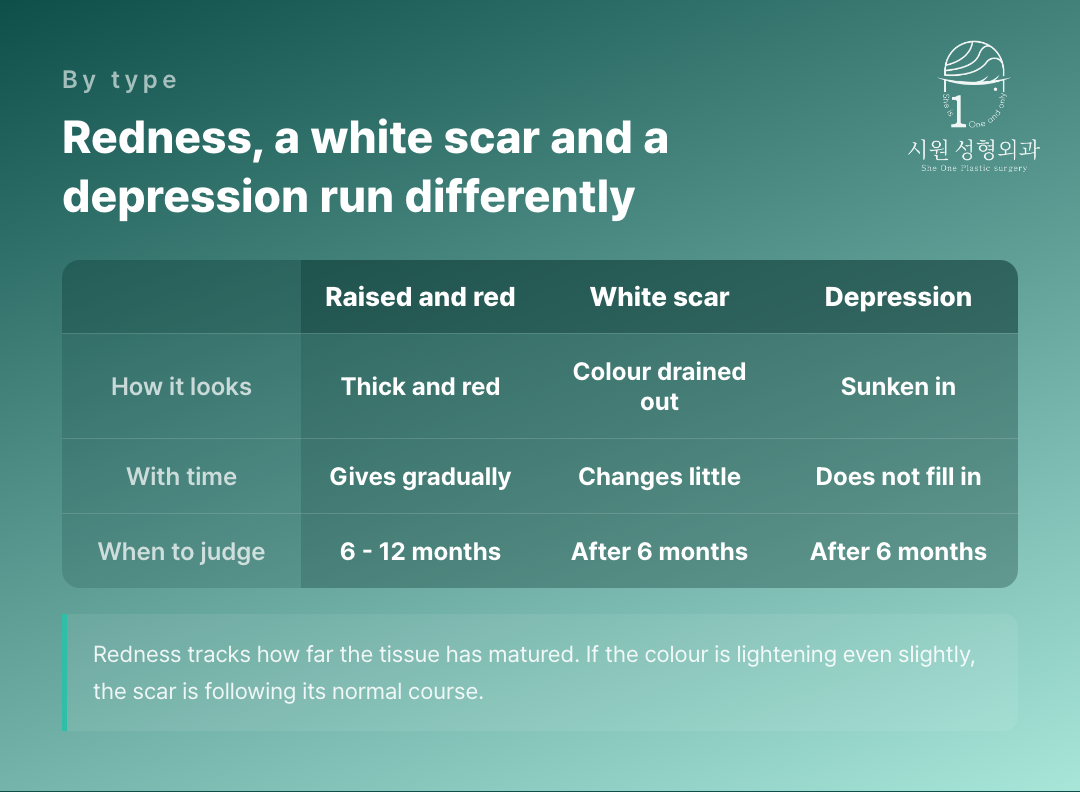
Literature on redness in scars describes this colour as closely tied to how far the tissue has matured, which makes it a useful indicator of where a scar is in its course. If the colour is lightening even slightly, it is following the flow.
What is different about a scar that sets white?
Sometimes the redness drains away and the colour does not come back, leaving the line white. The cells that make the colour of the skin at the incision have not found their place again, and in that state it is difficult for the area to return to the surrounding skin tone with time.
A hypopigmented scar of this kind differs in character from a red one. A case report treating hypopigmented scarring after surgery as a localised loss of pigment appears in the literature, which is to say the approach itself divides here. Whether this is the kind that improves with waiting has to be established first.
Does a depressed scar fill in with time?
An area that has already sunken does not rise again of its own accord. The depression is there because tissue is missing, and sometimes because the tissue beneath has adhered to itself.
The area dissected counts for more than the amount incised. A craniofacial surgery report covering 421 epicanthoplasties notes that dissecting more widely than necessary can leave a hypertrophic scar or a web-shaped deformity. Where a depression has settled across a wide area, restoring it in stages can be safer than covering it in one go.
Does care change the course?
Basic care — avoiding sunlight and not disturbing the wound — helps slow a scar from darkening. Where a silicone preparation is used, using it consistently is itself tied to the result.
A study of 79 patients with hypertrophic scars using silicone gel and gel sheeting examines how consistently patients used it against the state of the scar. What care can change, though, is the pace and the degree; the load on the suture line itself is settled in the surgical design.
What if nothing has changed by the usual point?
If six months have passed and the colour and thickness are no different from the start, the possibility of being off the course of natural recovery is considered. From that point, waiting is not the answer; it becomes a matter of establishing what is left.
When to consider restoration divides by the type of scar and by how much tissue remains. The standard for judging when restoration should be considered is set out separately, and why a restoration falls short usually begins with rushing that judgement.
What to establish in consultation
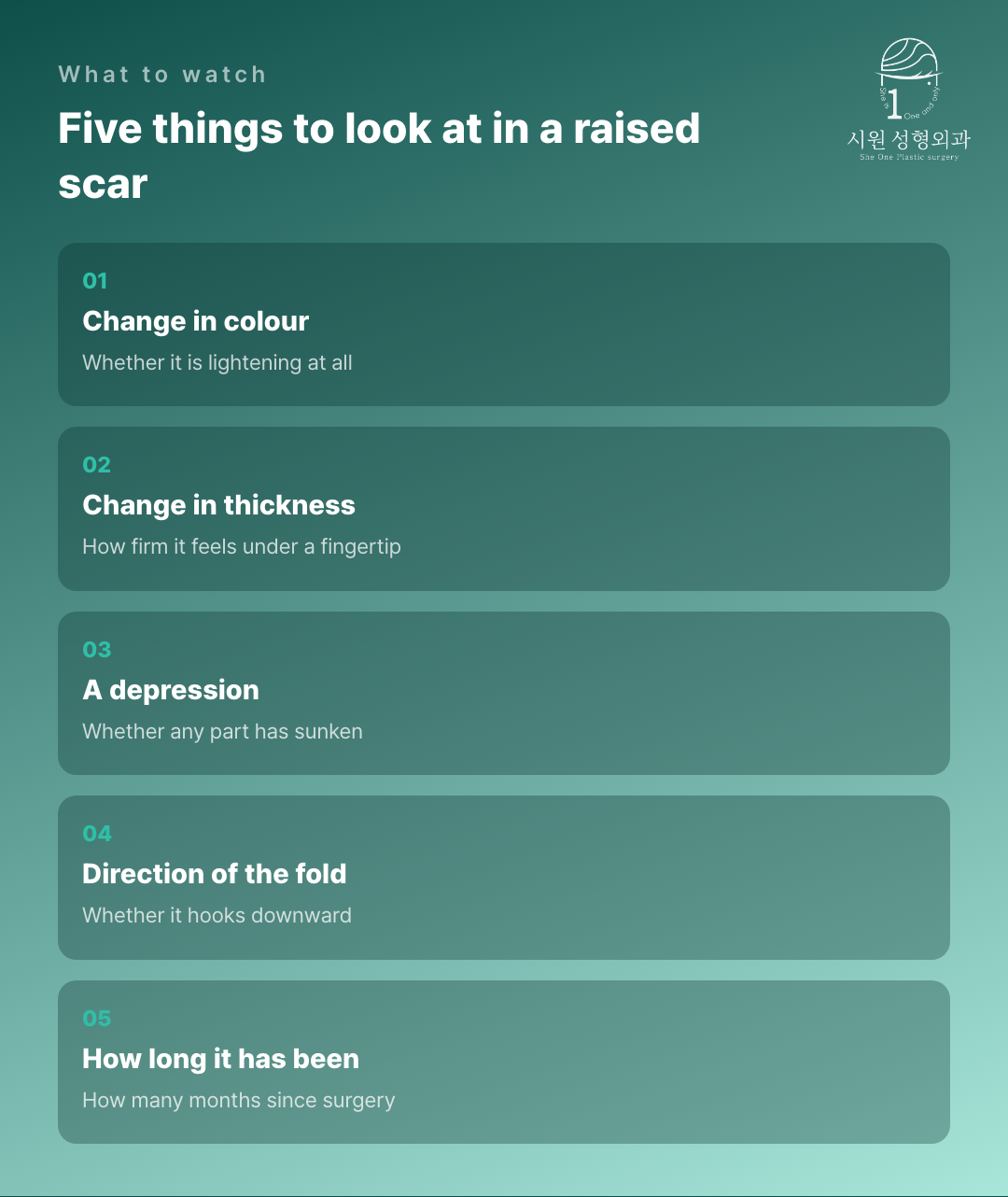
Rather than which procedure is used, it helps to look for somewhere that first establishes which type your scar is and how many months along it is.
- How many months it has been since surgery, and what change can be expected at that point
- Which of the three it is closest to — raised and red, white, or depressed
- Whether the colour or thickness has changed at all over the past month or two
- Whether this is a stage for waiting, or a stage for establishing what is there
- What care can change, and what it cannot
A raised inner-corner scar divides into the kind worth waiting on and the kind that is not. Both “it will improve if you wait” and “it needs attention now” are things that can only be said once the type has been established.
Waiting without knowing which kind you are waiting on is the hardest part, and it is the part a consultation should remove. Eye surgery is the only thing this clinic does, inner-corner restoration included, so the type and the stage are established before anything is proposed. If this is a scar to leave alone for another three months, that is what we will say — and we will tell you what to look for while you wait, so the waiting has something to check against.
Individual recovery times and results vary, and side effects can occur. Please consult our medical team before making any surgical decision.
WhatsApp ConsultationInternational patients welcome›
Official WebsiteProcedures and medical staff›
KakaoTalk ConsultationSend us photos and ask›
LINE ConsultationEasier if you are outside Korea›
DirectionsApgujeong Stn. · JJ Building 2F›
Consultations are held in English with the surgeon and our staff directly, not through an interpreter. Written enquiries in English are welcome.
2F, JJ Building, 19 Apgujeong-ro 28-gil, Gangnam-gu, Seoul, Korea
Mon–Fri 10:00 – 19:00 · Sat 10:00 – 16:00 · (KST, UTC+9)
Closed Sun & public holidays · +82-2-512-1889
