

Once an inner-corner opening is booked, recovery time becomes the thing you count. How many days to take off, and when it is safe to see people, are what the date gets chosen around.
Search for it, though, and the figures scatter — seven days, two weeks, a month. They differ because they are timing two different things. The point at which swelling goes down and the point at which the surgery stops showing are not the same, and it is usually the second one you want.
Swelling going down is not it stopping showing
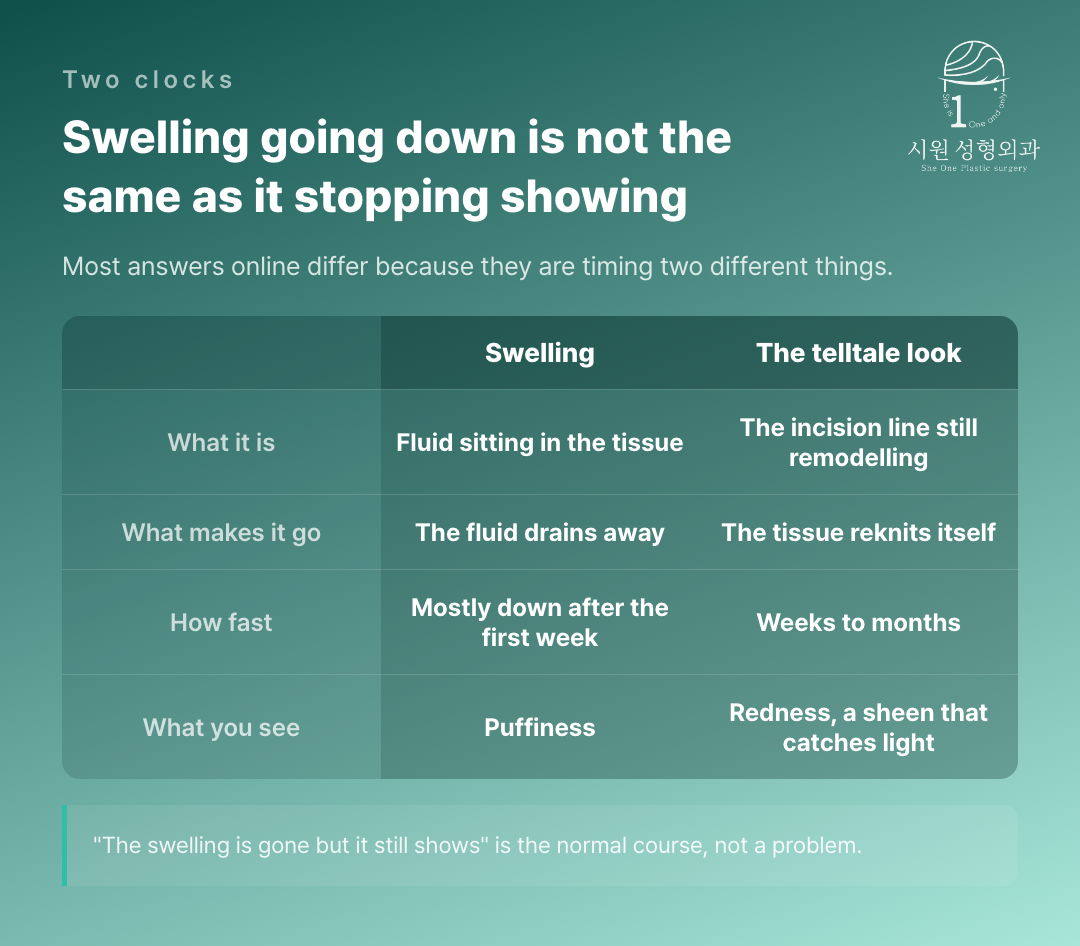
Swelling is fluid sitting in the tissue and then draining away, so it clears relatively quickly. Visible puffiness is mostly down once the first week is past.
The sense that it still shows comes from somewhere else — the incision line. While new tissue is being laid down the site carries a reddish tone, and in certain light the grain of it reads differently from the skin around it. That is not fluid leaving; it is tissue reknitting, and it takes longer.
This is why “the swelling has gone but it still shows” comes up so often. The two run on separate clocks. It is not an unusual course.
What people actually notice
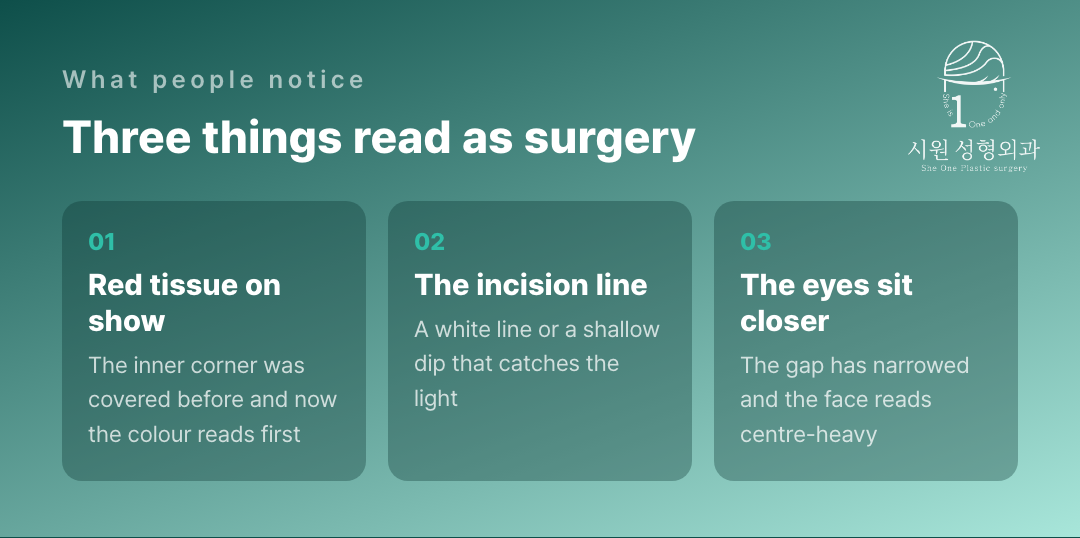
What reads as surgery narrows to three things. The first is red tissue at the inner corner showing from the front. An area that was covered before has been opened, and the colour is what registers first.
The second is the incision line left as a white line or a shallow dip that catches the light. The third is the gap between the eyes having narrowed, so the face reads as drawn towards its centre. The first two fade with time. The third stays as it is however long you wait.
That is why it helps to establish which of the three you are actually worried about before counting weeks. How much the gap can be expected to change at all is covered in what a first corner opening can and cannot do to the width of the eye.
Why the timing differs between people
Two people can have the same operation and stop showing it at different points. What counts for most is what is pulling on the healing site. If a sutured line heals while being drawn to either side, the mark cannot heal fine; it spreads, and the more it spreads the longer it is visible.
The inner corner is pulled every time the eye blinks, so that load is on it throughout. Depending on the direction the corner was opened, the pull either runs along the line or catches across it, and the one that catches lasts longer. Recovery looks like something that happens after the operation, but a good part of it is decided in the design.
Skin type works alongside it. Where a wound lays down a lot of new tissue as it closes, redness stays longer under the same conditions. That is constitutional and hard to know in advance; how scars from previous operations healed is the useful guide.
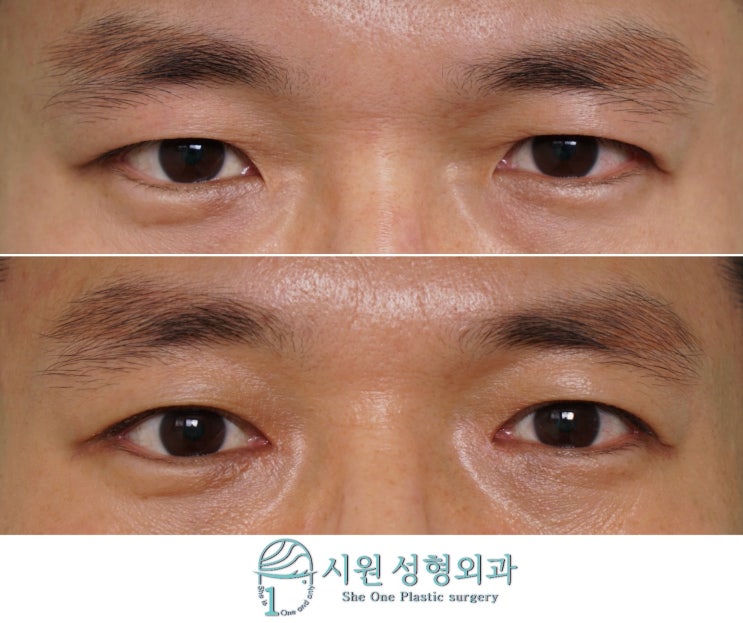
How an inner-corner recovery actually ran
A case on our official Naver blog, photographed through the course.
When swelling is slow to go and it starts to worry you — 43 photographs ›
What to wait out, and what to bring in
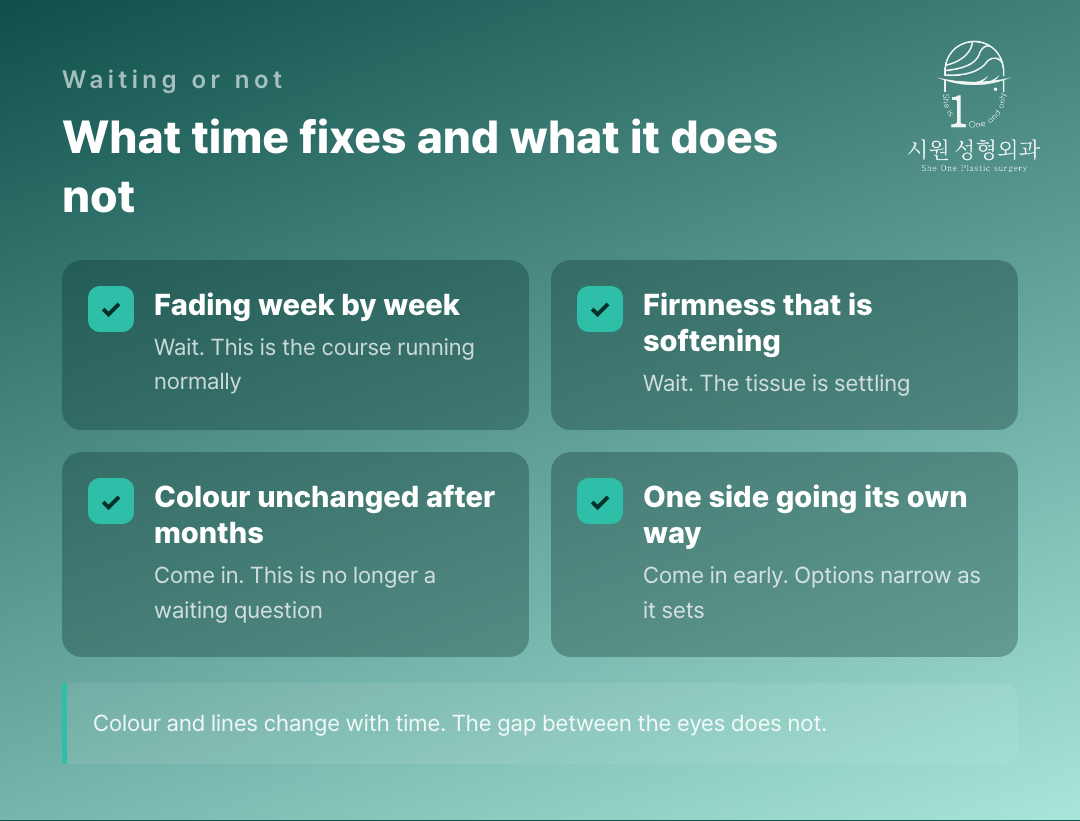
If the redness is easing week by week, that is the course running. Firmness that comes on and then gradually gives is the same. Time resolves both.
Where months pass and the colour has not moved, where one side alone is settling differently, or where a hooked fold forms below the inner corner, waiting is not the question. The shape is setting, and it needs to be seen directly.
An uneven pair is worth bringing in early in particular. Reworking one side and matching both are different operations, and the later it gets the fewer the options. Where six months have gone and nothing has changed, how to judge a scar that has not faded at six months is set out separately.
What you can do while it heals
Sunlight on a healing wound lets pigment settle in, and the redness lasts longer for it. Covering up when you go out makes a difference on its own. Rubbing the site or picking at it is worth avoiding too.
That is as far as care reaches, though. Whatever is pulling on a healed line is not something a cream or a strip can reduce. If you looked after it carefully and a mark was left anyway, that is not yours to answer for.
When you cannot tell on your own, let someone look
The hardest part of a slow recovery is not being able to tell, alone, whether this is a point to wait at or a point to act on. Eyes are the only thing this clinic looks at. Because corner openings and their restoration are both handled here, the current state can be weighed against both — whether it is passing through or setting. Where waiting is the answer, that is what is said.
The before and after photos featured in this post are shared with the patient’s explicit consent in accordance with the Medical Service Act. Individual recovery times and results vary, and side effects can occur. Please consult our medical team before making any surgical decision.
WhatsApp ConsultationInternational patients welcome›
Official WebsiteProcedures and medical staff›
KakaoTalk ConsultationSend us photos and ask›
LINE ConsultationEasier if you are outside Korea›
DirectionsApgujeong Stn. · JJ Building 2F›
Consultations are held in English with the surgeon and our staff directly, not through an interpreter. Written enquiries in English are welcome.
2F, JJ Building, 19 Apgujeong-ro 28-gil, Gangnam-gu, Seoul, Korea
Mon–Fri 10:00 – 19:00 · Sat 10:00 – 16:00 · (KST, UTC+9)
Closed Sun & public holidays · +82-2-512-1889
